


Key Takeaways
-
AI's binding constraint is shifting from compute to memory: token usage is projected to grow 24x by 2030, pushing memory toward 50% of hyperscaler AI capex by 2028.
-
Supply can't keep up: HBM consumes ~4x the wafers of standard DRAM, meaningful new capacity won't arrive until late 2027, and even 20–30% supply growth still trails demand — sending DRAM prices up more than 8x and NAND more than 5x over the past year.
-
Memory chip sales are projected to more than triple, from $216 billion in 2025 to $748 billion by 2027; with a more consolidated, disciplined industry and still-low valuations.
The Nvidia H100 is currently the industry’s leading GPU for AI computing, featuring 80GB of high-bandwidth memory (HBM). Its successor, the B200, expands this to 192GB, with the next-generation R200 expected to reach 288GB.1 This rapid growth in memory capacity reflects a core reality: AI performance is increasingly constrained not by computing power, but by available memory.
The AI Scaling Problem
AI is scaling at an unprecedented pace. Token usage, the amount of data processed by AI systems, is expected to grow nearly exponentially, with Goldman Sachs estimating a 24x increase by 2030.2
As the industry shifts from chat-based AI to agentic systems, memory demands are expanding across multiple dimensions. Agents run continuously, users may deploy several simultaneously, and agents can coordinate with one another. Together, these dynamics require significantly longer context windows, meaning more memory is needed to store and process data.
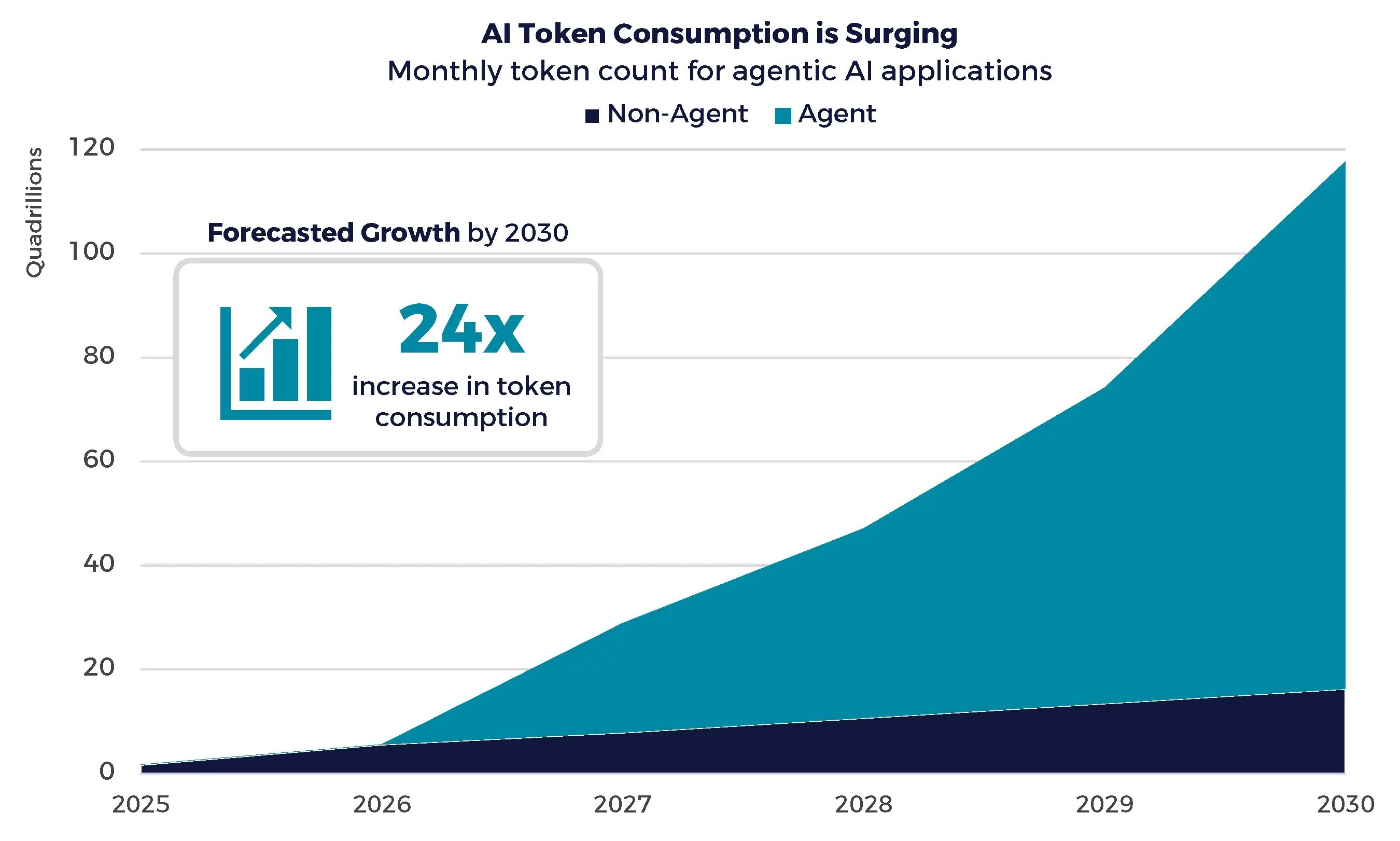 Source: Goldman Sachs, May 2026
This demand for memory is already influencing hyperscaler behavior. In 2026, an estimated 35% of hyperscaler AI capex is allocated to memory, rising toward 50% by 2028.3 Overall AI-driven memory demand is expected to increase roughly fivefold over the next five years, with additional upside as AI extends beyond centralized data centers to edge and real-world applications.4
Memory Is Not a Monolith
Not all memory serves the same role in AI systems. These distinctions, while technical, are important to understanding the bottleneck:
| Acronym | Description | Explanation |
| HBM | High-Bandwidth Memory | The fastest and most advanced form of memory, stacked directly alongside GPUs. HBM enables extremely high data throughput, which is critical for training and running large AI models. It is also the most complex and capacity-constrained segment, requiring significantly more wafers and advanced packaging. |
| DRAM | Dynamic Random Access Memory | General-purpose system memory used across servers and data centers. DRAM is slower than HBM but far more widely deployed and flexible. It serves as the backbone for most compute workloads, including AI inference and supporting processes. |
| NAND | Flash Storage | A slower, non-volatile form of memory used for storage rather than active computation. While it cannot match DRAM or HBM speeds, NAND is significantly cheaper, creating growing interest in offloading portions of AI workloads, such as context storage, to NAND through software and architectural innovation. |
This hierarchy reflects a trade-off between speed, cost, and scalability, which is becoming increasingly critical as AI systems expand.
Supply Is Struggling to Keep Up
Expanding memory supply is inherently a multi-year process. New capacity requires building fabrication facilities, installing equipment, qualifying production, and reaching efficient yields.
HBM, in particular, is consuming a disproportionate share of industry resources. Each unit requires roughly four times as many wafers as conventional DRAM due to packaging complexity and lower yields.5 As the mix shifts toward HBM, effective industry capacity tightens.
Most analysts expect meaningful supply additions for DRAM and NAND only by late 2027. Even then, estimated supply growth of 20-30%6 is unlikely to keep pace of demand.
Rising Prices Reflect a Structural Bottleneck
The imbalance between supply and demand is already evident in pricing. Memory prices have increased sharply over the past year, with DRAM up more than 8x and NAND up more than 5x,7 while inventory levels have fallen to historically low levels.
Memory Prices Have Soared Over the Past Year
$ per memory component, spot price
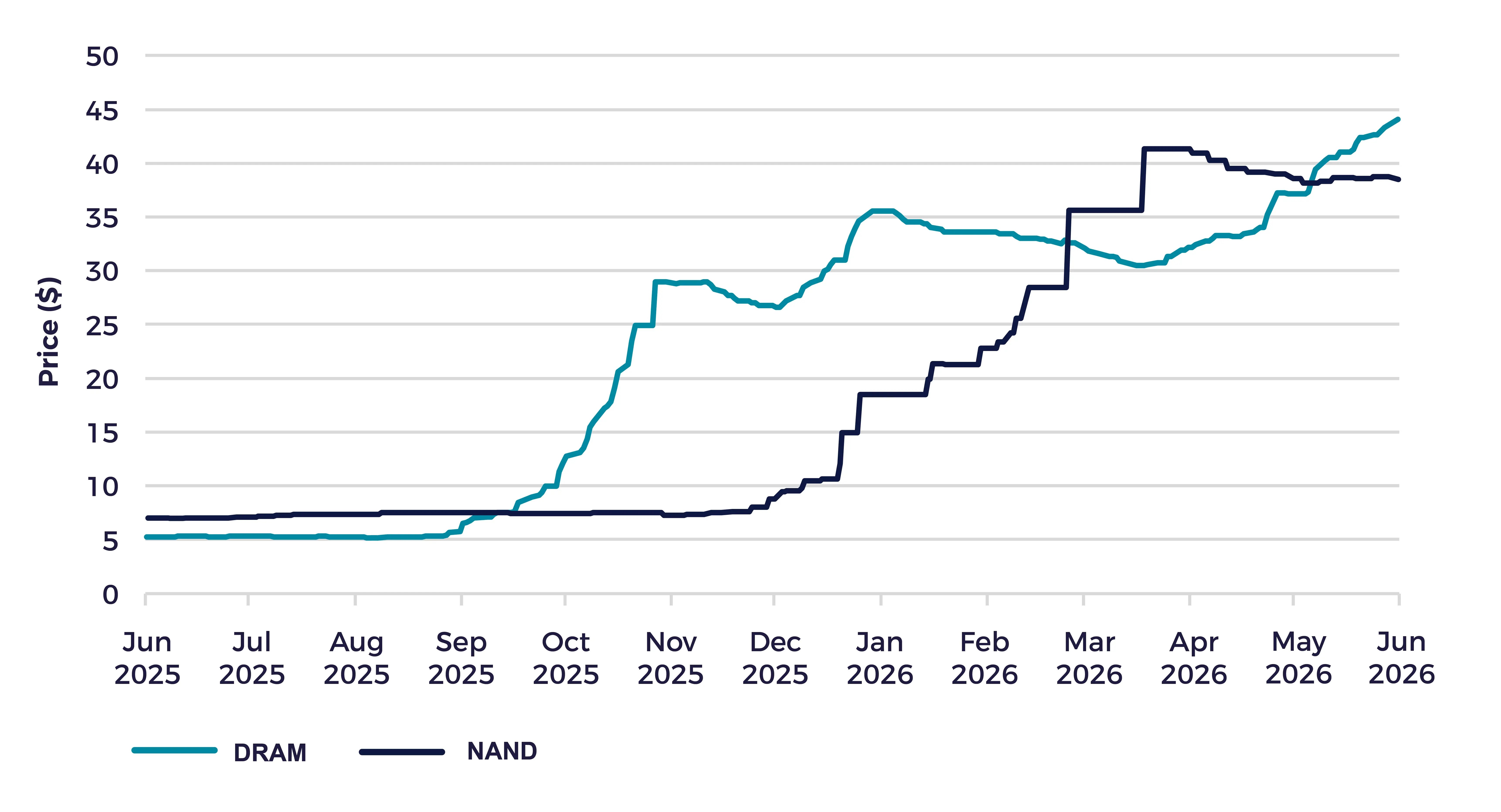 Source: Bloomberg, Jun 2026
Long-term supply agreements are becoming more common, helping to stabilize pricing and improve visibility for both buyers and producers.
NAND Continues to Stand Out
As hyperscalers continue to invest in AI infrastructure, a shift is emerging. While HBM and DRAM remain essential for performance, their cost is driving efforts to move portions of AI workloads to lower-cost NAND.
Advances in software and system design are enabling more efficient use of NAND for storing and managing AI context. This creates a potential tailwind for pure-play NAND manufacturers such as SanDisk (SNDK) and Kioxia (TYO: 285A).
Memory Companies Stand to Benefit
Industry revenue is expected to grow significantly, with memory chip sales projected to more than triple from $216 billion in 2025 to $748 billion by 2027.8
Given that much of this growth is price-driven, a substantial portion is expected to flow through to profits. Unlike prior cycles, consolidation has left the industry with a smaller number of more disciplined players, contributing to improved industry structure.
Despite these dynamics, valuations remain relatively low, reflecting skepticism about the durability of current profitability levels.
For investors seeking exposure, the Tema Memory ETF (DISK) provides actively managed access to leading global companies across HBM, DRAM, and NAND, positioned to benefit from memory’s central role in AI infrastructure.