

Key Takeaways
-
Healthcare is forecast to exceed 20% of U.S. GDP,1 yet its weight in the S&P 500 has fallen to a decade low,2 leaving its economic importance underrepresented in public markets.
-
As AI becomes indispensable to healthcare, we expect that disconnect to close, driven by faster drug discovery, higher clinical success rates, better economics for companies, and improved outcomes for patients.
-
The Tema Healthcare AI ETF (HLTH) is the first purpose-built solution targeting companies at the leading edge of AI transformation in healthcare.
AI is powering a new productivity revolution, creating compelling opportunities for investors across a wide range of industries. But there's a critical sector poised for transformation that investors may be overlooking: healthcare. Nearly one in every five dollars of U.S. economic output is spent on healthcare,1 a share that continues to rise. Yet healthcare is underrepresented in a typical equity portfolio, representing just 8.9% of the S&P 500 index.2 That disconnect exists despite an acceleration in spending.
U.S. Healthcare Spending Is Set to Nearly Double
Spend relative to % of U.S. GDP, 2024- 20341
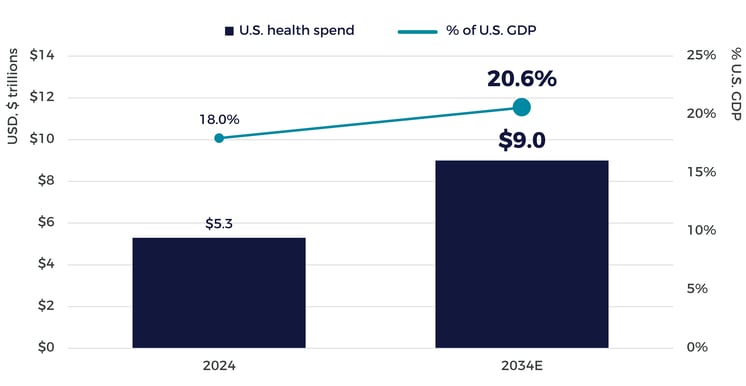
Source: Centers of Medicare & Medicaid Services, NHE Fact Sheet, as of Jul 2026
Healthcare Needs AI
Healthcare systems are being asked to serve more patients, manage greater complexity, and improve outcomes without a corresponding increase in available resources. Across care delivery, administration, and drug development, structural constraints are limiting productivity and increasing costs:
-
Labor Shortages: The WHO estimates a global shortfall of 11 million healthcare professionals, as longer lifespans and aging populations place growing demands on care systems.3
-
Waste: Nearly $1 trillion in U.S. healthcare spending is lost to waste each year, driven by administrative complexity, pricing failures, fragmented care, overtreatment, and fraud.4
-
Pipeline Productivity: Just 6.7% of drugs entering Phase I trials ultimately receive approval, forcing developers to pursue many candidates to produce a single.5
AI offers a path to relieve these constraints by extending the capacity of healthcare professionals, reducing inefficiencies, and improving decision-making across the system.
Where AI Can Help Most
These constraints also point to where AI can have the greatest impact. Across the healthcare system, AI can support a limited workforce, reduce administrative waste, and improve decision-making clouded by fragmented data and care pathways.
The opportunity is particularly significant in drug discovery, where AI is beginning to transform biology into an engineering discipline. By making biological systems more predictable and computable, AI can help researchers identify stronger candidates earlier, reduce unproductive work, and accelerate the development of potentially game-changing treatments.
Drug Discovery Timelines Are Shrinking
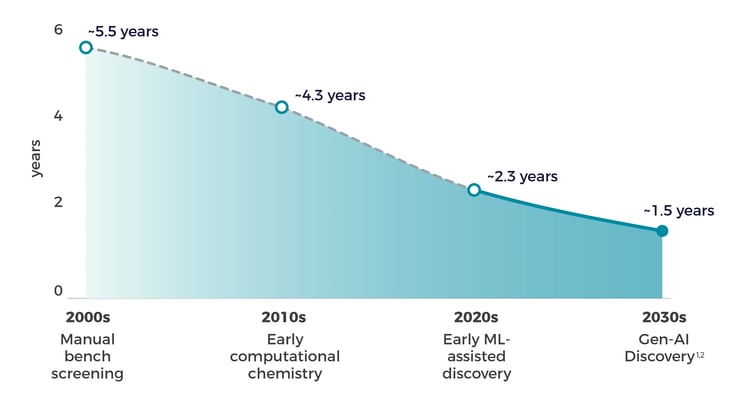
Sources: Ren et al., Nature Biotechnology, 2024 (Insilico Medicine) & Sumitomo Dainippon Pharma & Exscientia, 2020. Note: Timeline reflects target identification to preclinical candidate only; excludes clinical trials and regulatory review. Historical (2000s–2020) figures are illustrative estimates.
Faster discovery does not eliminate the scientific and clinical risks inherent in drug development. It can, however, improve the probability of success throughout development, potentially enabling more drugs to reach the market and increasing the expected value of healthcare companies.
Momentum Behind the Thesis
The healthcare AI thesis is being validated by some of the world’s most ascendant companies, perhaps none more so than Anthropic. The company's leadership has said AI could compress a century of biological progress into a decade,6 and it has moved to back that vision. In the first half of 2026 alone, Anthropic acquired drug discovery startup Coefficient Bio,7 added former Novartis CEO Vas Narasimhan to its board,8 and launched Claude Science,9 a dedicated computational biology platform.
Anthropic is far from alone. DeepMind's protein folding model, AlphaFold, won a Nobel Prize in Chemistry in 2024 and is now used by more than 2 million researchers,10 a rare case of an AI tool becoming standard lab equipment only a few years after release. Pharmaceutical companies have taken notice too: NVIDIA alone has committed $1 billion over five years to a joint drug discovery lab with Eli Lilly, one of 45 AI partnerships the industry struck between 2025 and May 2026.11 Capital flows support the anecdotes: healthcare and pharmacy combines to represent the third largest category of global private AI investment.
HLTH Offers a Pure-Play Solution
For many investors, AI exposure has become nearly indistinguishable from owning the mega-cap technology leaders that dominate the S&P 500 and Nasdaq-100 indexes. What they’ve lacked is a pure-play way to target companies at the leading edge of AI’s transformation of specific, economically vital sectors—and we believe none offers greater potential than healthcare.
The Tema Healthcare AI ETF (HLTH) provides actively managed exposure to companies leveraging AI to transform healthcare across drug discovery, diagnostics, clinical applications, and patient care.
For fund objectives, holdings, and risk information once available, visit temaetfs.com/HLTH.