


Key Takeaways:
-
CXMT is China’s leading DRAM producer and just listed on Shanghai’s STAR Market, bringing a major new memory player to public markets.
-
Rapid revenue growth, improving profitability, and rising wafer capacity are pushing CXMT toward the scale of established global competitors.
-
The Tema Memory ETF established a 10.56% position in CXMT on the day of its July 27 IPO, giving U.S. investors meaningful exposure to a leading memory producer they cannot otherwise access directly.
ChangXin Memory Technologies, better known as CXMT, has emerged as China’s leading producer of dynamic random-access memory, or DRAM.
The company grew from an unusual combination of entrepreneurial ambition, imported expertise, and state support. Founder Zhu Yiming previously founded GigaDevice. Engineering talent and intellectual property came in part from Qimonda, the former European DRAM producer that entered bankruptcy in 2009. The Hefei municipal government then provided the long-term capital needed to build capacity and absorb early losses.
That foundation has now produced a memory manufacturer with increasing global relevance.
Fundamentals Are Accelerating
CXMT’s financial profile has changed rapidly. Revenue increased 156% year over year to $8.6 billion in 2025.1 The company then generated an estimated $7.3 billion in the first quarter of 2026 alone, while margins expanded to 70%.2
SemiAnalysis forecasts that full-year revenue could exceed $50 billion this year, supported by strong DRAM pricing and a market that could remain structurally undersupplied through 2028.3
CXMT is also challenging the assumption that Chinese semiconductor producers compete primarily on price. Its DRAM products are reportedly priced only 5% to 10% below comparable Korean and American products, suggesting customers increasingly view CXMT as a credible supplier rather than simply a lower-cost alternative.4
Domestic Demand Ballast
CXMT benefits from a large domestic customer base seeking greater security of supply. Alibaba is both an anchor customer and an approximately 4% shareholder. Tencent, ByteDance, Baidu, and other Chinese technology have signed multiyear LTAs worth billions of dollars.5
This demand is reinforced by China’s broader effort to reduce its reliance on imported semiconductors. CXMT therefore combines commercial demand, strategic importance, and continued government support.
Approaching Global Scale
CXMT is already nearing the scale of the established memory producers.
SemiAnalysis expects the company to exit 2026 with approximately 350,000 wafer starts per month (wspm), compared with roughly 385,000 for Micron. Capacity could reach 560,000 wafer starts per month by the end of 2028, equal to almost 18% of global DRAM.6
CXMT Is Emerging as a Major Source of Global DRAM Capacity
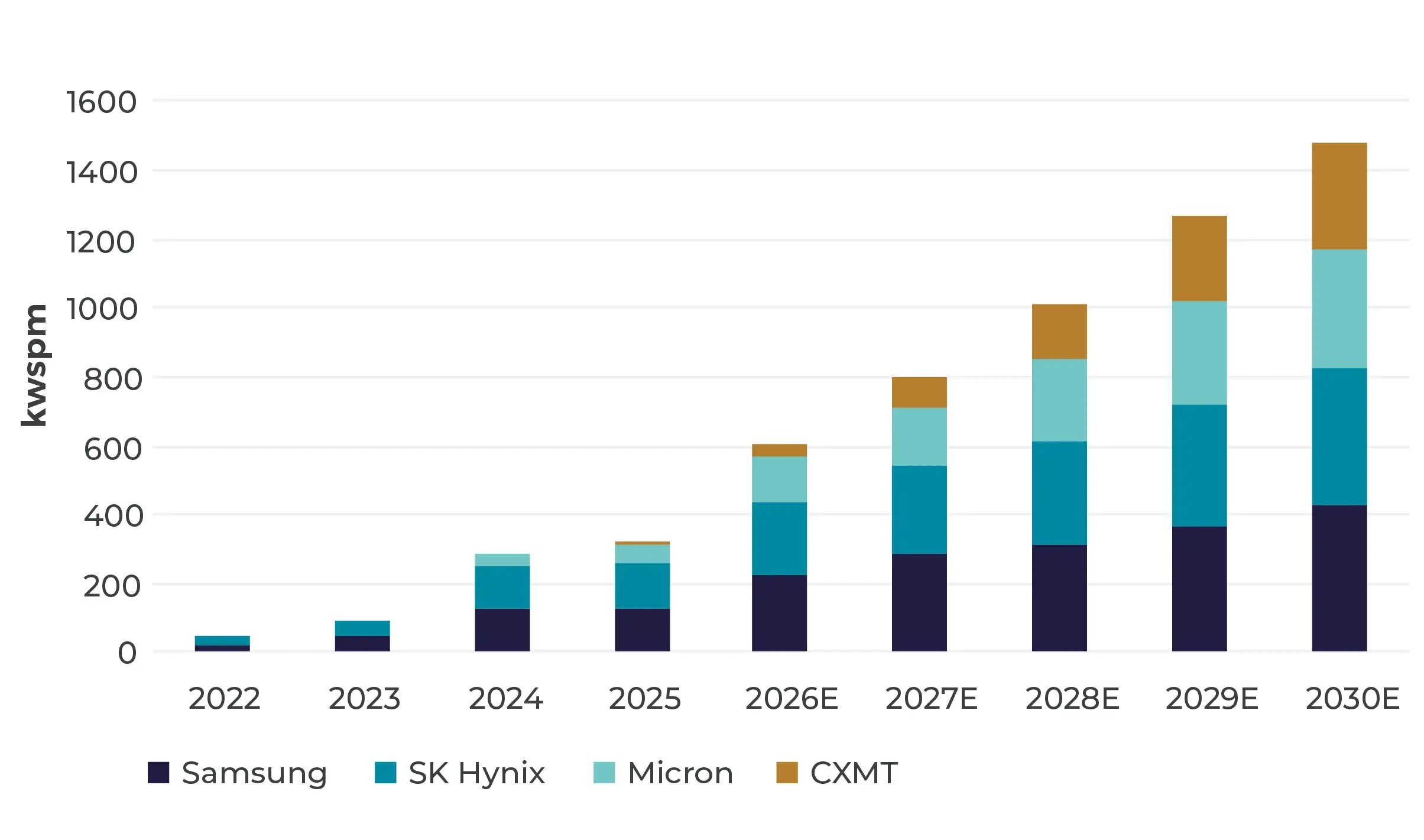 Source: SemiAnalysis Memory Model. kwspm = thousand wafer starts per month
These trends would make CXMT one of the largest memory manufacturers in the world. Importantly, its expansion is occurring during a favorable pricing environment, allowing the company to scale without necessarily disrupting the broader market.
HBM Creates Further Upside
CXMT also has meaningful potential in high bandwidth memory (HBM), a critical component of AI infrastructure. SemiAnalysis estimates that CXMT’s share of global HBM wafer capacity could rise from 1% today to nearly 18% by 2028.7 Export restrictions limit China’s access to advanced HBM produced elsewhere, creating a captive domestic market that includes Huawei, Cambricon, and a growing group of Chinese accelerator developers.8
The Bottom line
CXMT is moving from a domestically supported challenger to a globally relevant memory producer. Its fundamentals are accelerating, its manufacturing footprint is approaching the scale of established competitors, and its HBM ambitions provide exposure to China’s expanding AI ecosystem.
The emergence of CXMT demonstrates why active management matters in memory. Through the Tema Memory ETF (DISK), investors can access opportunities beyond familiar U.S. and Korean leaders, including hard-to-access companies like CXMT from their first day of trading.
DISK is the first institutionally managed memory ETF launched in partnership with SemiAnalysis, the leading independent research firm specializing in semiconductors and AI infrastructure.