


SpaceX’s rumored $2 trillion valuation may sound excessive for a company often described as a “rocket manufacturer.” But that framing increasingly misses the point. SpaceX is less a rocket company and more the infrastructure layer for a future space economy—one where falling launch costs unlock entirely new industries, business models, and ultimately access to resources far beyond the limits of Earth.
What is SpaceX?
SpaceX today is a vertically integrated space company:
-
A manufacturer of rockets (Falcon 9, Falcon Heavy, Starship) and satellites (Starlink)
-
A provider of launch services for both its own and customer payloads
-
Owner of the Starlink satellite constellation and related Starlink broadband service
-
Owner of xAI—the AI lab behind Grok, with 2GW+ of data center capacity (300 MW recently leased to Anthropic)—and of X, the social network.
Starlink Alone May Justify the Valuation
The first step in understanding SpaceX’s valuation is Starlink, its satellite broadband business, with over 10 thousand satellites in orbit.
Starlink already appears capable of justifying much of the $2 trillion valuation on its own. It is one of the fastest-scaling communications networks in history, reportedly generating $11.4 billion of revenue in 2025 with $7.2 billion of EBITDA1 from an estimated 9 million subscribers2. The number of subscribers is projected to double in 2026.3
The long-term opportunity is massive. Roughly 4 billion people globally remain unconnected or underserved by broadband.4 Even if only 300 million eventually become Starlink subscribers (less than one-in-seven), the economics are becoming very compelling.
At $50/month (half the current cost), 300 million subscribers would generate $180 billion of annual revenue. At a 70% EBITDA margin—plausible considering Starlink is already around 60% margins at an early stage—the business could generate $125 billion of EBITDA annually. A $2 trillion valuation only requires a relatively modest multiple of 16x EBITDA.
And that likely excludes much of the company’s upside.
Lower Launch Costs Can Unlock Entirely New Industries
SpaceX’s real advantage is that it has fundamentally changed the economics of accessing space. Through reusable rockets and extreme vertical integration, launch costs have fallen roughly 90% over the past decade.5 At the same time, SpaceX’s launch cadence is now unmatched globally, enabling faster deployment, iteration, and scaling than competitors can realistically replicate.
SpaceX Now Dominates Launching Objects Into Orbit
Annual launches relative to other private and sovereign entities
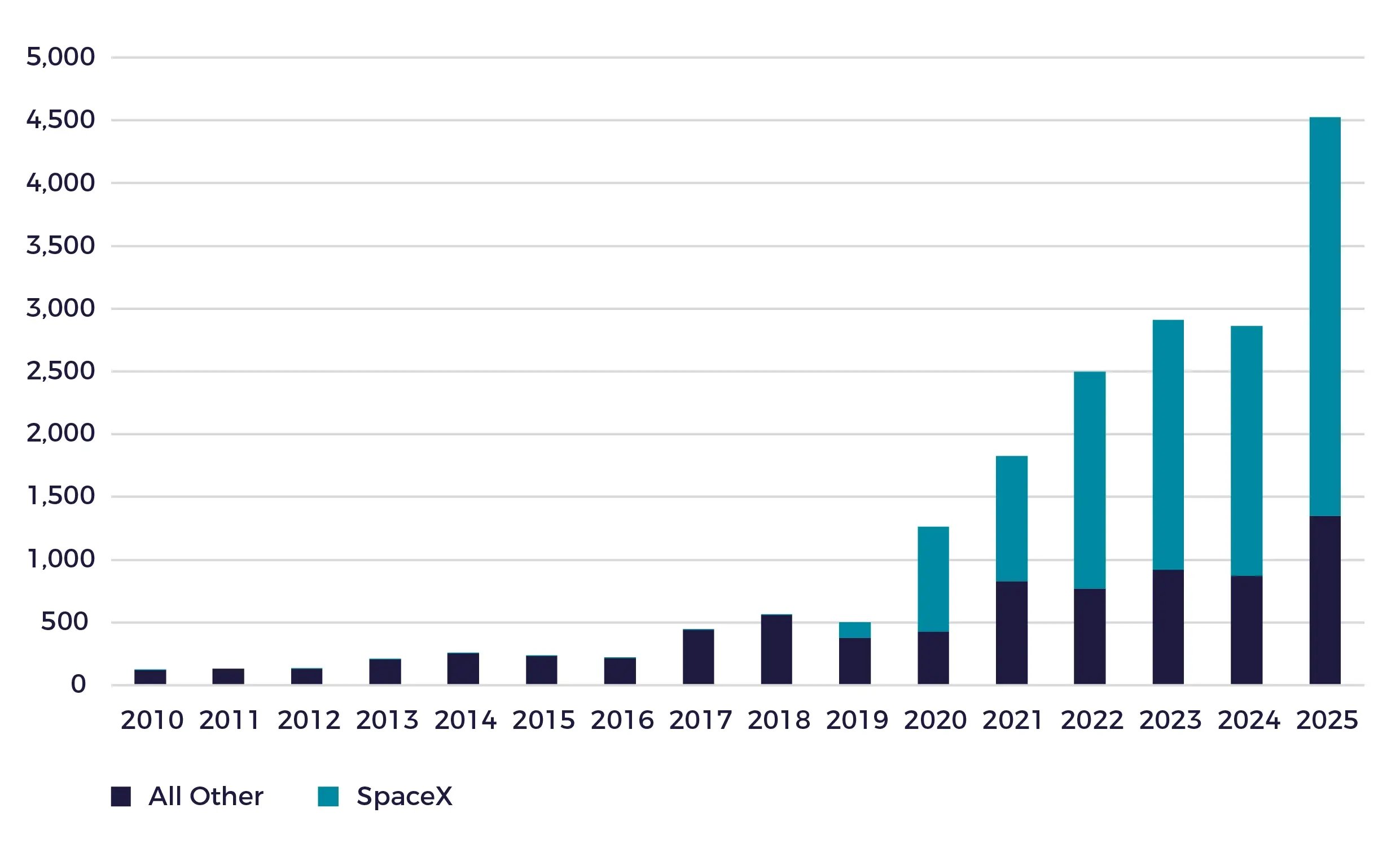
Historically, many space applications were not economically feasible, due to prohibitive launch costs. That appears poised to change. Lower launch costs could enable entirely new industries including space-based manufacturing, data centers, defense systems, and eventually industrial activity beyond Earth.
Declining Launch Costs Enable Further Space Advances
Launch cost per kilogram to low earth orbit (LEO)
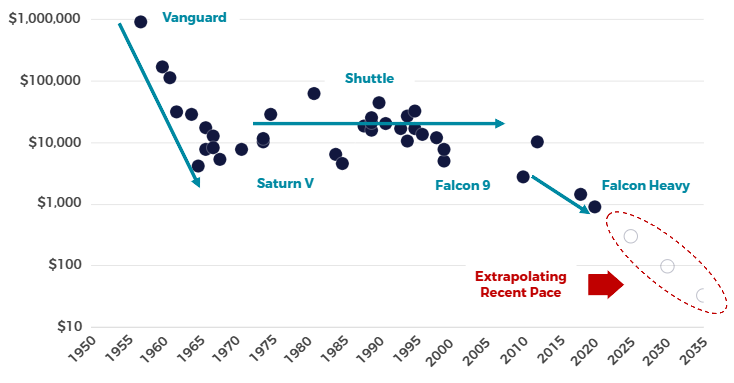 Source: Jones, Harry W. “The Recent Large Reduction in Space Launch Cost,” NASA Ames Research Center, July 2018
The Long Game
Economic growth is ultimately constrained by access to energy and resources. Nearly all usable energy on Earth originates from the Sun—yet only a tiny fraction of the Sun’s total energy output reaches Earth.
By expanding into space, humanity potentially gains access to near-limitless solar energy and vastly larger resource availability. Over time, energy-intensive computing, manufacturing, and industrial infrastructure may increasingly migrate off-planet, where power is abundant and physical constraints are dramatically reduced.
In that sense, SpaceX is not merely a transportation company. It is potentially the platform that allows civilization to expand beyond the resource limitations of Earth itself. While this may sound like science fiction, it wouldn't be the first time an Elon Musk company bent the assumed laws of business physics.
SpaceX as the Infrastructure Layer for the Space Economy
Importantly, investors may not even need to believe in these aspirations to justify today’s SpaceX valuation. If Starlink becomes the provider that delivers broadband at scale to the world's underserved—as it appears well positioned to do—the economics could plausibly support a multi-trillion-dollar valuation on their own.
The broader space economy—enabled by dramatically lower launch costs—may represent additional upside that is difficult to quantify today. SpaceX could become the foundational infrastructure layer for humanity’s expansion into space.
The Bottom Line
For investors seeking access to SpaceX, the Tema Space Innovators ETF (NASA) is the only pure-play space ETF that holds a pre-IPO position through an SPV in the company.
Disclosure: SpaceX is a private security accessed through an SPV and is 5.52% of NASA holdings as of Jun 12, 2026. Private investments held through SPVs carry additional risks. Consider fund risk and objectives before investing. For current fund information, holdings, and the prospectus, visit the NASA fund page.