


Key Takeaways
-
Prediction markets are an emerging asset class with rapidly growing volumes
-
Kalshi is now the dominant U.S. platform, commanding 52% of total volumes, an estimated $1.5 billion revenue run-rate, and a recent $22 billion valuation1
-
Kalshi's business model resembles traditional exchanges (e.g., CME Group, Cboe Global Markets): Asset-light, transaction-fee driven, and reinforced by compounding network effects
Recently the Tema Durable Quality ETF (TOLL) became the first ETF to offer exposure to Kalshi through an SPV*—the leading, CFTC-regulated event contract exchange. Kalshi is privately held, and this article lays out our rationale for the investment.
What Are Prediction Markets?
Prediction markets—also known as event contracts—are simple financial instruments that resolve to either Yes ($1) or No ($0) based on real-world outcomes. For example, a contract like “Will the Federal Reserve cut rates at its next FOMC meeting?” trades between 0 and 100 cents, effectively reflecting the market-implied probability of the event.
Prediction Markets Are Booming and Kalshi Is Winning
Trading on these markets, spanning sports, economics, and politics, has exploded in the past two years.
Prediction Markets are Booming and Kalshi is Taking Share
Weekly Prediction Market Notional Volume
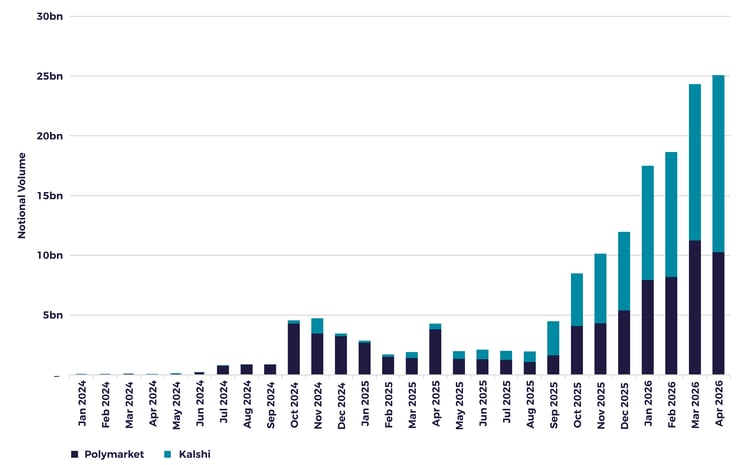 Source: Dune Analytics, as of Apr 20, 2026
This growth is driven by their simplicity, expanding breadth of tradable events, and improving liquidity including from institutions. Beyond trading, these markets are increasingly viewed as valuable information sources, with research from the Federal Reserve suggesting they can outperform traditional surveys and futures in forecasting outcomes such as interest rates.2
The market is currently led by two players: Polymarket and Kalshi. Founded in 2018 and regulated by the Commodity Futures Trading Commission (CFTC), Kalshi has emerged as the leading U.S. venue. The company has scaled rapidly, reaching an estimated $1.5 billion revenue run-rate and a $22 billion valuation.3
Why Is Kalshi a Durable Quality Business?
Kalshi’s business model resembles that of traditional exchanges such as CME Group, Intercontinental Exchange (parent company of the New York Stock Exchange), and CBOE Global Markets. It earns transaction and data fees without taking market risk, creating an asset-light, scalable model.
Kalshi benefits from tangible regulation and technological exchange infrastructure. Liquidity begets liquidity: As more participants trade, spreads tighten and market quality improves, attracting incremental users. Kalshi has consistently taken share, accelerating its dominance through innovation and strong partnerships, such as with the brokerage platform Robinhood.
Today, Kalshi is the market leader, commanding 52% of total volumes traded. Partnerships with financial infrastructure providers (Clear Street4, Jump Trading5, Susquehanna6) further reinforce this dynamic, positioning Kalshi as a foundational layer in a potentially large new asset class. Kalshi has the potential to upend traditional exchanges through direct ownership of retail trading channels, as event contracts could “financialize everything.”
Kalshi Through the Lens of Tema’s Investment Process
-
Does the firm have a solid operating base? Yes, the company has a strong technological, regulatory, and market infrastructure asset base. It is led by outstanding co-founders and backed by world-class investors like Sequoia.
-
Does the firm have a solid balance sheet and cash flow generation? Kalshi recently raised $1 billion and has a long runway to execute its growth strategy. Growth investments aside, the firm is profitable and cash-generative.
-
What is the valuation case? Kalshi is attractively valued relative to growth prospects. At $1.5 billion ARR and a $22 billion valuation, Kalshi is currently valued at 15x EV/Sales. This is in-line with CME, which trades on 14.5x forward EV/Sales—though a mature company with high margins and slower growth. Other exchanges typically trade on 9-12x EV/Sales.
-
What is our edge? We feel the market is not appreciating the power of network effects in exchanges. Additionally, Kalshi uniquely owns customer relationships adding a further layer to its moat.
What Are the Risks?
Some of the most popular contracts on Kalshi relate to sports, which has attracted the attention of state authorities. While this remains a risk, the company’s strong track record of regulatory engagement, federal standing with the CFTC, and industry adoption7 suggest the overhang of state risk to be manageable.
The Bottom Line
For the Tema Durable Quality ETF (TOLL), Kalshi represents a high-growth, category-defining platform with exchange-like economics, powerful network effects, and significant long-term optionality. If successful, it could emerge not merely as a betting platform, but as core market infrastructure for pricing uncertainty itself.
For more of our research and recent insights on durable quality and more, view and subscribe to our insights.