


Key Takeaways
-
The U.S. tariff framework has evolved, but the mechanism matters less than the intent. Executive support for domestic manufacturing remains intact regardless of which legal authority is in use.
-
Those expecting realignment after the mid-term elections may be disappointed for a variety of reasons—trade and industrial policy are likely to continue flowing not from Congress but through executive action.
-
Middle East conflict is disrupting the flow of critical commodities—oil, gas, fertilizers, and industrial inputs—without easy substitutes or a clear resolution timeline. Supply chain stress has returned to COVID-era highs, turning nearshoring from a long-term strategic conversation into a near-term operational one.
Three macro and geopolitical developments continue to influence the manufacturing and supply-chain outlook this year: evolving tariff policy, the approaching U.S. mid-term elections, and elevated tensions in the Middle East. These dynamics may collectively reinforce incentives for domestic manufacturing investment. Here’s why.
Tariffs Aren’t Going Away
Tariff policy remains fluid. Since Liberation Day, the legal framework has evolved multiple times through both court rulings and administrative actions. The Supreme Court struck down the IEEPA-based regime in February. The administration replaced it with a Section 122 surcharge that sunsets in July—but that deadline is better understood as a pressure point than an endpoint. Additional tariff mechanisms remain available and the administration's underlying objectives have not changed.
Businesses planning around a July resolution may be planning around the wrong question. For companies evaluating domestic production capacity, the broader takeaway may be that support for U.S. manufacturing remains a policy priority, even as the legal mechanisms continue to evolve.
An Unusual Election Season
Conventional wisdom holds that the party in power usually suffers heavy losses in mid-term elections after a new president is elected. 2010 and 2018 are examples of such “wave” election years. However, 2022 proved less one-sided than pundits expected, and several factors could make 2026 another precedent-breaker.
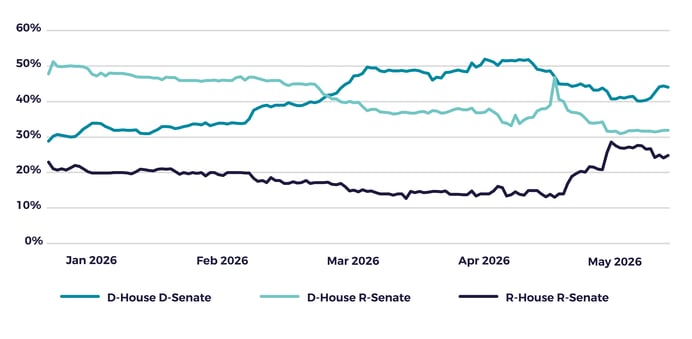
Most notably, mid-decade redistricting is reshaping congressional maps in real time. Prediction markets earlier this year implied strong odds of unified Democratic control of government following the 2026 elections. More recently, those expectations have moderated as redistricting developments improve the GOP electoral outlook—and the likelihood of a Congress aligned with the administration's agenda.
Conventional Wisdom About the Mid-Terms May Be Wrong—Again
Predicted balance of power after the 2026 congressional elections
 Source: Kalshi, as of May 22, 2026
Regardless of the balance of power after the mid-terms, the two years leading into a presidential election are typically less productive legislatively. This threatens to be especially true with an open primary in both parties that will incentivize declared presidential candidates as early as January, as we saw in both 2008 and 2016. Such long campaigns are inevitably a distraction to governing.
Such dynamics do not constrain trade policy—they push it through the executive branch. The Supreme Court's IEEPA ruling drew a narrow line on emergency powers; the traditional statutory tariff authorities have survived decades of litigation. With a 6-3 conservative majority on the Court, the legal scaffolding for executive action is sturdier than headlines suggest.
Ultimately, what often gets lost in the political debate over tariffs is that the underlying objective—rebuilding U.S. manufacturing—commands genuine bipartisan support. The disagreement is over method, not direction.
Geopolitics Casts a Long Shadow
Middle East conflict is doing more than raising fuel prices—it is actively disrupting the physical flow of commodities that underpin global manufacturing. Oil, natural gas, fertilizers, and industrial inputs like helium are all subject to supply shock risk when conflict destabilizes extraction, transit, or export infrastructure across the region. These are not margin-line costs; they are inputs without easy substitutes, and shortages cascade unpredictably through supply chains far removed from the conflict itself.
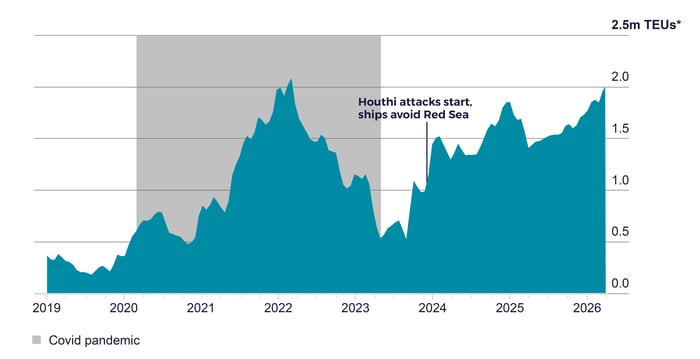
The World Bank's Global Supply Stress Index tells the story: In April 2026, the gauge surpassed 2 million TEUs for the first time since March 2022. When supply chain stress rivals COVID-era highs and the underlying cause is active conflict rather than a temporary demand surge, the calculus around nearshoring shifts. Not as long-term strategy, but as near-term operational necessity.
World Bank's Global Supply Stress Index
Gauge jumped over 2 million in April for the first time since March 2022
 Source: Bloomberg, as of May 22, 2026
Why This Matters for Investors
Taken together, several developments may continue to support domestic manufacturing investment over time. Trade policies implemented through executive authority, elevated transportation and energy costs, ongoing fiscal support from legislation such as the CHIPS Act and IIJA, and the domestic investment and tax provisions included in the OBBB law.
Collectively, these incentives should continue encouraging investment in domestic manufacturing capacity and supply-chain localization. For investors seeking exposure to this theme, the Tema U.S. Manufacturing & Reshoring ETF (WELD) invests in companies positioned to benefit from a potential resurgence in domestic manufacturing, industrial activity, and infrastructure development.