


Key Takeaways
-
Nvidia’s selloff shows how one company’s problems can ripple across a portfolio.
-
Sharp declines in mega-cap stocks are more common than many investors realize.
-
A concentrated index leaves investors making big bets on individual stocks, even as market leadership keeps changing.
Nvidia’s selloff is a reminder of a risk we flagged earlier this year: The S&P 500 has a concentration problem. The stock fell as much as 14% intraday on Thursday, Nov 12, following Jensen Huang’s resignation as CEO, before paring its losses to close down 4.3%.1 The details are specific to Nvidia, but the portfolio lesson is broader. Owning 500 companies does not mean an investor is insulated from single-stock risk.
The S&P 500 remains a compelling way to participate in the long-term growth of leading businesses in the world’s largest economy. The companies driving that growth, however, change over time.
The Cost of Concentration
On Sep 30, Nvidia represented roughly 8.3% of the S&P 500. The 10 largest companies together accounted for nearly 40%.2 For perspective, at an 8.3% starting weight, a hypothetical 10% decline in Nvidia alone would subtract 0.83 percentage points from the portfolio’s return, assuming every other holding was unchanged.
As a stock outperforms, its share in a market-cap-weighted index generally rises. Investors have more riding on it by the time its fortunes turn. Its weight then declines as the stock underperforms, but only after investors absorb the loss.
Sharp Drawdowns Are Common
Nvidia is hardly an isolated example. Meta fell 26.4% in a single session in Feb 2022, and Amazon lost 14% in one day that April.3,4 This year, Microsoft dropped 10% in January and Alphabet fell 12.6% in October.5,6 Even the market’s largest, most established businesses can be repriced sharply when expectations change. A concentrated index leaves investors more exposed to these recurring, difficult-to-predict setbacks.
The Leaders Keep Changing
The comparison below puts that rotation in perspective. General Electric led the S&P 500 at year-end 2000. Exxon Mobil held the top spot in 2010, followed by Apple in 2020 and Nvidia in Sep 2026. Only Microsoft appears in the top 10 at all four dates.2,7
The S&P 500 Marches Higher—Not All of Its Leaders Keep Pace
Top 10 companies by weight in 2000, 2010, 2020 and 2026
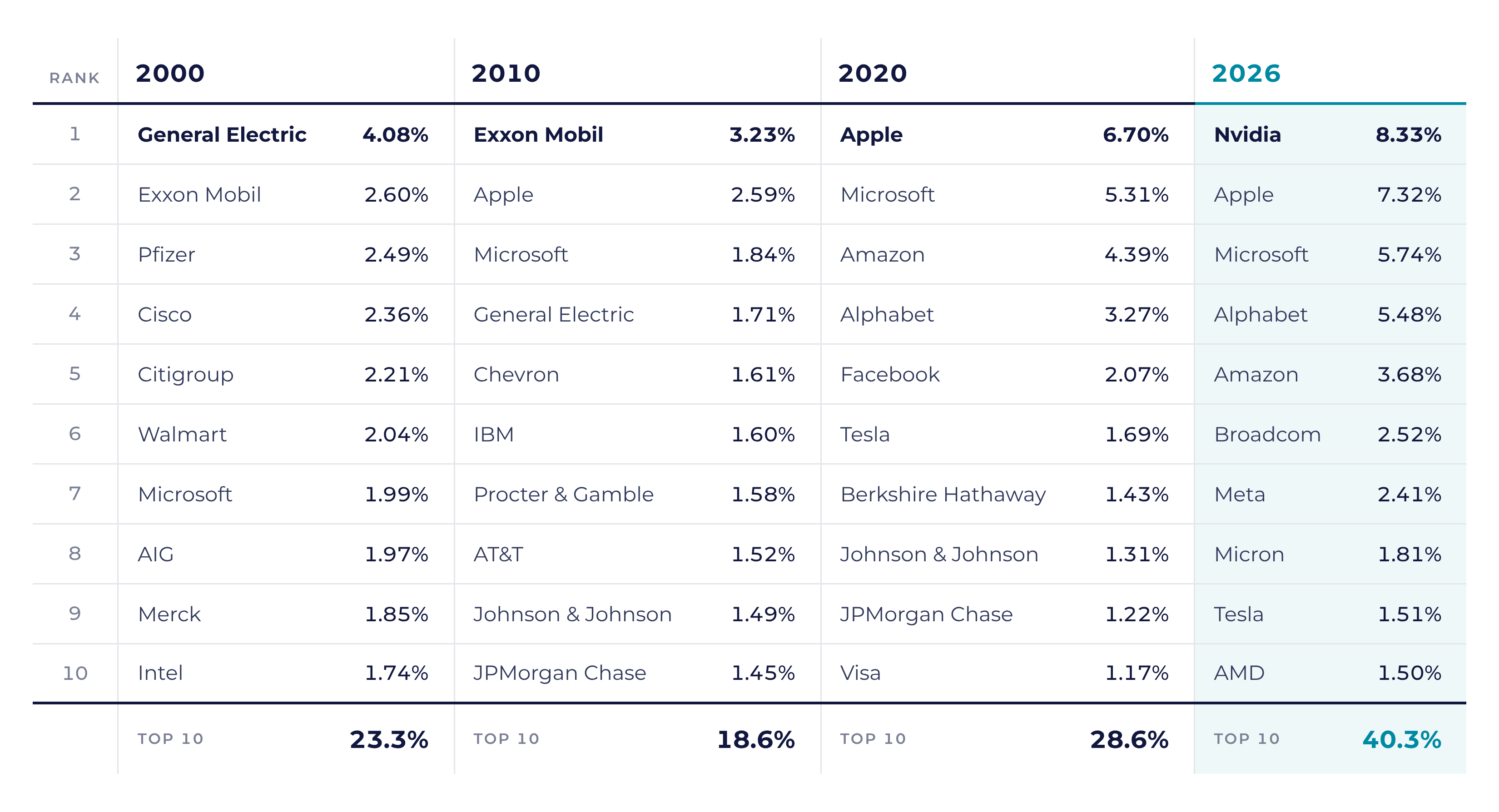 Source: Bloomberg. Data as of Dec 31, 2000, 2010 and 2020, and Sep 30, 2026.
Leadership changes as industries evolve, competition intensifies, and valuations reset. The broader market can keep advancing while individual leaders lose ground and new ones emerge. A concentrated portfolio gives those rising businesses less room to offset setbacks at the top.
Why This Matters for Investors
Investors can stay invested in the S&P 500 while reconsidering how much they allocate to its largest names. Equal weighting reduces concentration by giving each company roughly 0.2% at each quarterly rebalance. That makes the largest business no more influential than the smallest.
The Tema S&P 500 Historical Weight ETF Strategy (DSPY) offers a different approach. DSPY invests in the same companies, in the same rank order as the S&P 500, but with weights based on the historical average for each rank. The result is lower concentration risk, without the complete dilution of equal weighting. Investors therefore don’t need to identify the next Nvidia to decide how much of their portfolio should depend on the current one.