


Key Takeaways
-
A wave election has raised risks for data center development and driven a selloff in AI-related stocks.
-
Big picture: Strong forward earnings estimates support a positive outlook.
-
Opportunities extend into AI power, healthcare, commodities, and manufacturing.
Democrats’ sweeping gains in Congress, governors’ races, and state legislatures have raised the political stakes for the AI buildout.1 Data center and related infrastructure stocks sold off sharply as investors weighed tighter oversight and construction delays2—a reaction we believe is misplaced.
The election arrived against a strong earnings backdrop. The S&P 500’s consensus earnings per share estimate for the next 12 months reached $413 on November 2.3 We remain positive on stocks and AI, despite political uncertainty. Opportunities extend to power infrastructure, healthcare, commodities, and manufacturing—the businesses enabling AI’s growth and putting it to work.
S&P 500 Earnings Expectations Continue to Rise
Next 12 months EPS estimates (daily)
Source: The Compound Media, data via Bloomberg.
Voters Weigh In on Data Centers
Data centers became one of the surprise issues of this campaign. Before the vote, a Reuters/Ipsos poll found that 57% of Americans would oppose a data center in their community, and 77% worried AI would push up their electricity bills.4 The election results bore that out, and a slower data center buildout has become the market’s main takeaway from the vote.
The market’s first reaction split along a clear line. Infrastructure stocks sold off while the largest cloud providers rallied. Two things explain the gap. First, the hyperscalers are better insulated. They have a large pipeline of projects already underway that aren’t being stopped, and their finances can absorb delays. Second, the market had already been voting against the buildout. Early in the fourth quarter, investors discounted these companies for record capital spending that has eaten deeply into their free cash flow. When news broke that construction may slow, the stocks rallied on hopes that cash burn will ease.5
The longer lasting effect may be on what already exists. When new projects get harder to approve, data centers that are built and connected to power become more valuable. That reinforces a point we’ve made repeatedly: The real bottleneck is power.
Power Sets the Pace
U.S. data centers will need 97 gigawatts of additional power by 2028. Projects under construction account for 21 gigawatts, and available grid capacity adds another 19. That leaves a 57-gigawatt gap.
The shortage explains the rush to secure power. SemiAnalysis estimates that a $5 billion power plant supporting one gigawatt of computing capacity could enable roughly $100 billion in annual AI inference revenue. Under those assumptions, about 20 days of gross revenue would match the plant’s cost. That comparison excludes the other costs of building and running a data center.6
With grid connections taking years, developers are turning to onsite gas turbines, engines and fuel cells. FTAI Aviation (FTAI) is even adapting aircraft engines for the job. Nuclear power may help over time. The opportunity spans the businesses that generate electricity, move it and supply the equipment along the way.6,7
U.S. Data Centers Could Face a 57 GW Power Shortfall
Estimated cumulative power needs, available supply and potential shortfall, 2026–2028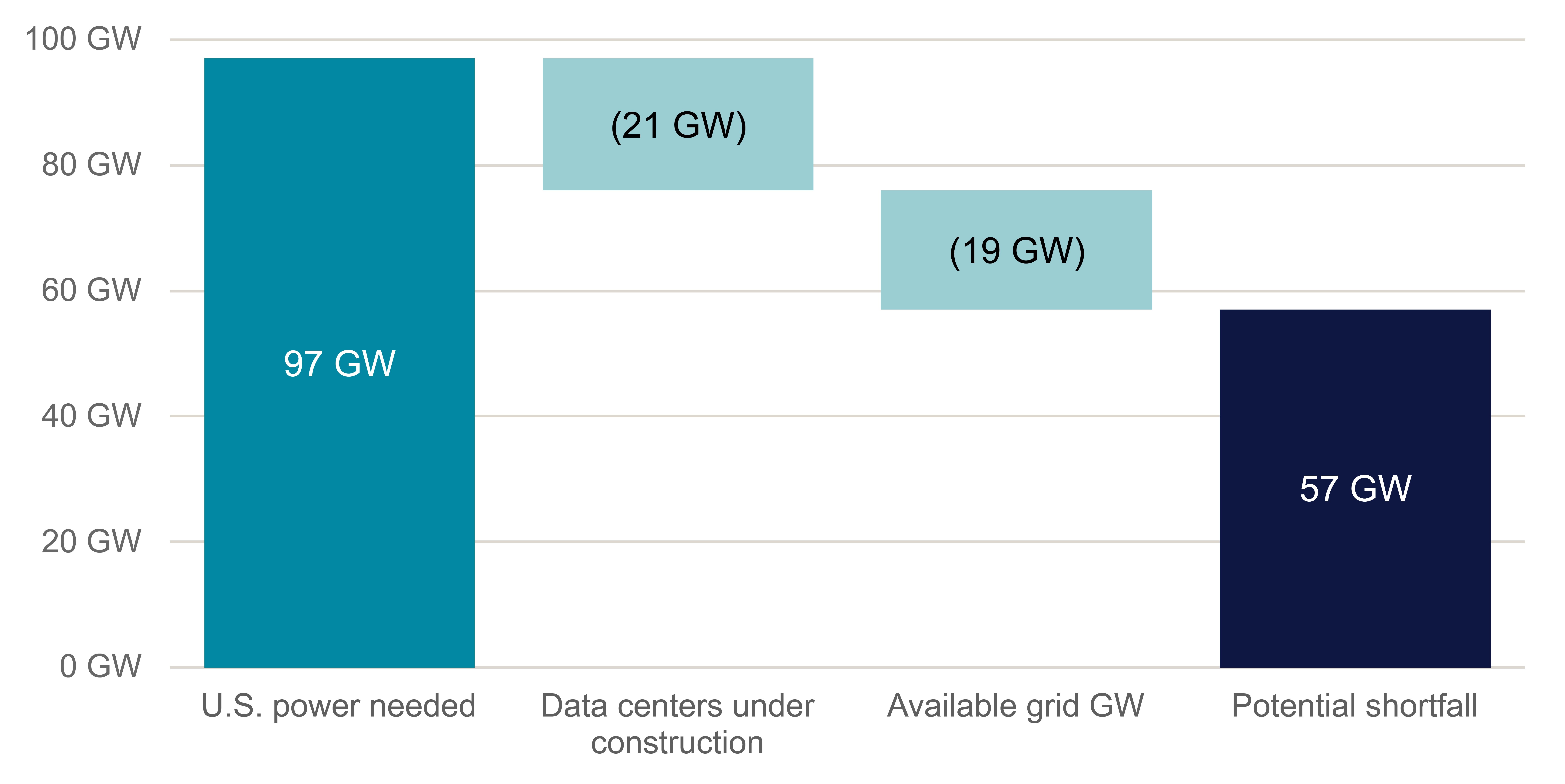
Source: Morgan Stanley, Sep 2026, via Financial Times.
Healthcare Brings AI Into the Lab
Healthcare offers another way to participate in AI’s growth. Models can design experiments, automated labs can run them, and the results can help improve the next round.
Danaher (DHR) plans to launch an AI-powered autonomous lab that brings those steps together. Biohub’s expanded research initiative includes Google DeepMind and Isomorphic Labs. The White House has also announced $2.4 billion in industry commitments for scientific tools and computing, including $1 billion from NVIDIA (NVDA).8,9,10
For investors, that opens opportunities in lab equipment, diagnostics and patient care. The key is whether these tools improve results and become part of everyday practice.
Digital Growth Needs Physical Resources
AI and the return of U.S. manufacturing both need copper, steel, energy and equipment. Together, they could create more demand for these inputs than either trend would on its own.
New resource supply can take years to develop. That makes production costs, asset quality, and spending discipline especially important. The opportunity includes both resource producers and the companies that build, equip and connect their operations.
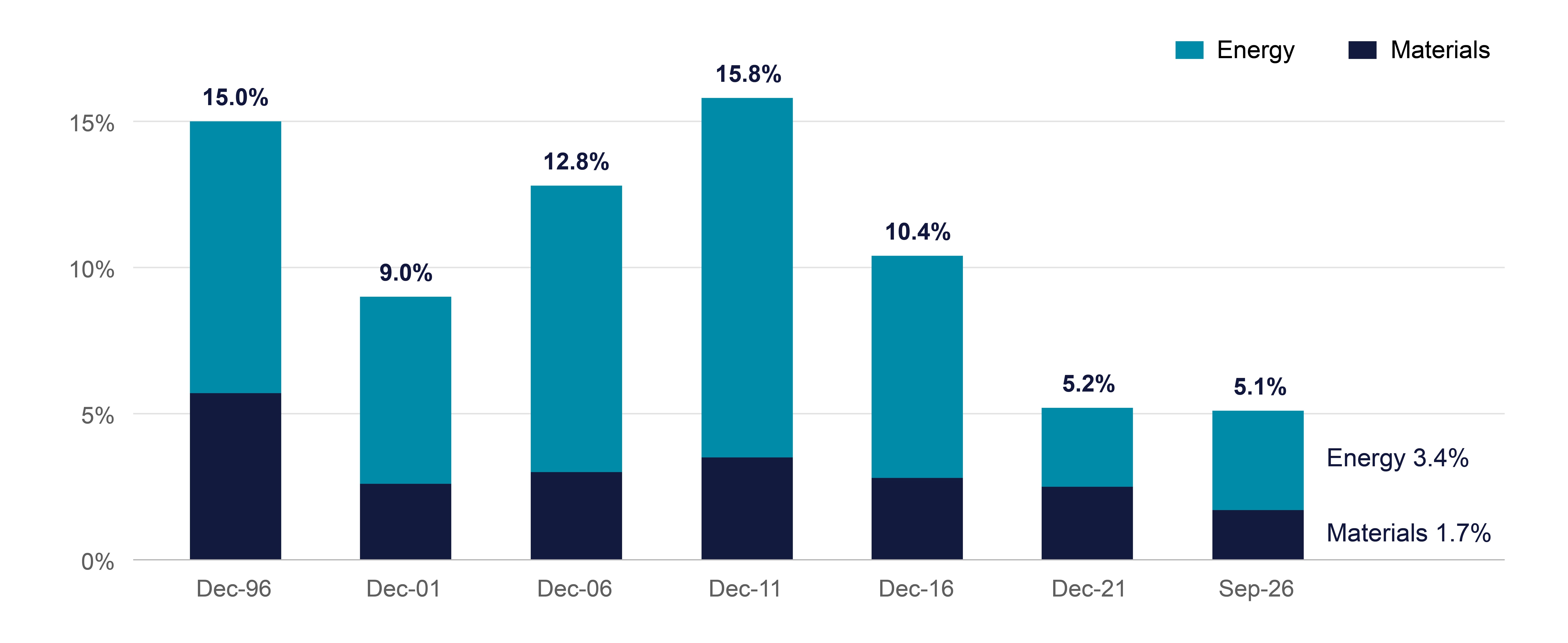
Broad stock indexes offer surprisingly little exposure here. Energy and materials together made up just 5.1% of the S&P 500 at the end of September. Investors looking beyond technology should consider how much of these businesses they already own.
Energy and Materials Represent Less than 6% of the S&P 500
S&P 500 sector weights (%), 1996–2026
Source: Bespoke Investment Group. Year-end weights through 2021. 2026 weights as of Sep 30; Bloomberg, Sep 2026.
Automation Makes Reshoring More Productive
Robotics brings AI into physical work. Anthropic estimates that physical tasks account for 46% of U.S. working time. Automating them will depend on whether robots can do the job reliably and at a competitive cost.11
Factory automation, machine vision, and motion control already offer ways to invest in that shift. They also help make domestic manufacturing more competitive. Bringing production home is easier when companies can raise output and keep costs under control.
Why This Matters for Investors
Markets have swung sharply since the midterms. In our view, investors would be well served to zoom out and focus on the fundamentals, including a strong labor market and a healthy earnings outlook. AI remains a potentially massive driver of long-term economic growth, despite near-term uncertainty over where data centers will be built and how quickly.