


What Past Cycles Tell Us About the Broadening to Come
Key Takeaways
-
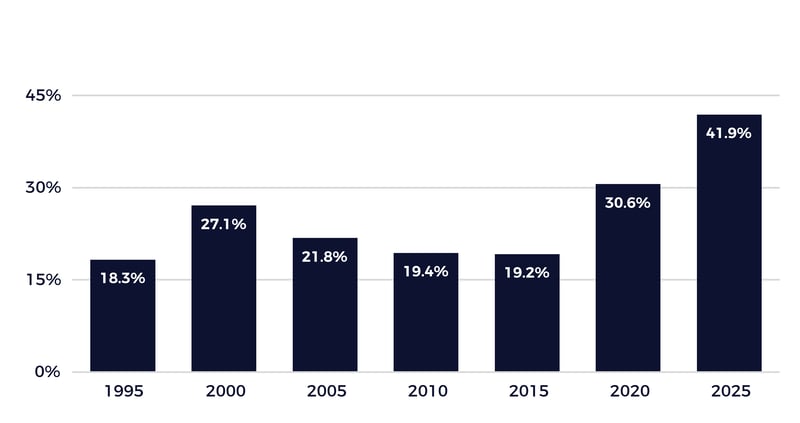
Concentration in the S&P 500 is near a record high. The top 10 stocks ended 2025 representing more than 40% of the index¹—far exceeding both their earnings contribution and prior cycle peaks.
-
Easing financial conditions and signs of improving breadth suggest the next phase of market leadership should extend beyond mega-caps.
-
Historical weighting offers a pragmatic middle ground, reducing concentration without the blunt dilution of popular equal-weight strategies.
Today’s Concentration Is Extreme
Many investors recognize that the S&P 500 has become top-heavy. But the magnitude can still surprise. At year-end 2025, the 10 largest companies made up more than 40% of the index.¹ By contrast, at the height of the dot-com era in 2000, top-10 concentration peaked around 27% .¹ In other words, today’s concentration isn’t just high—it’s nearly 50% above the prior high-water mark.
S&P 500 Concentration Far Exceeds the Dot-Com Era Peak1
Peak Weight of the 10 Largest S&P 500 Companies by Year
Source: Bloomberg, as of Feb 13, 2026
This is more than a statistical curiosity—it has real portfolio construction implications. While the top 10 companies account for more than two-fifths of index weight, they generate less than one-third of total index earnings.² The gap between weight and earnings contribution means investors in the cap-weighted S&P 500 are paying a premium for concentration at the top, whether they intend to or not.
Rate Cuts Are Usually Bullish—With One Caveat
When rates fall, borrowing becomes cheaper. This typically helps a wider range of companies—especially those with more debt, long-duration cash flows, or sensitivity to financing costs. Industries like housing and construction, consumer discretionary, and utilities tend to see top-line growth pick up as financial conditions ease.
Last year, the Federal Reserve delivered 75 basis points of rate cuts. With markets pricing additional easing in 2026,3 financial conditions are becoming increasingly supportive for a wider set of companies.
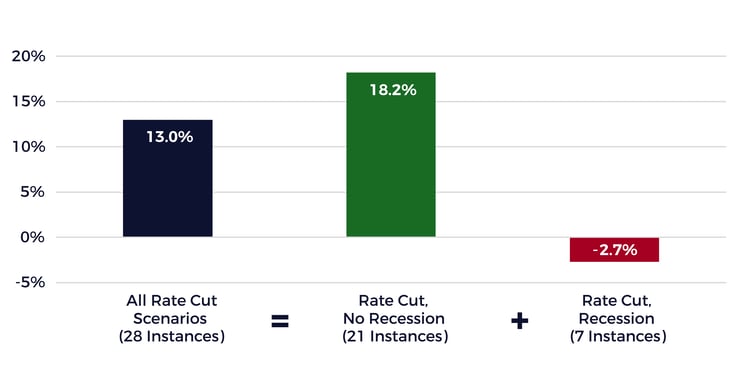
History reinforces this backdrop. Since 1984, when the Fed has cut rates while the S&P 500 was within 3% of an all-time high and no recession followed, the market delivered positive returns every time over the subsequent 12 months, with an average gain of more than 18%.4
Rate Cuts at Record Highs Have Been Good for Investors4
S&P 500 Returns 12 Months After a Rate Cut, When Within 3% of All-Time Highs
Source: MarketWatch, as of Sep 24, 2025
Breadth Is Already Improving
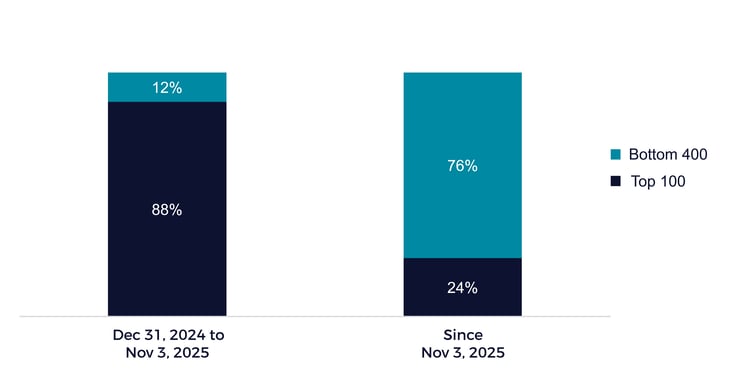
Against a backdrop of political polarization, sharp swings in commodity and crypto prices, and an otherwise noisy macro environment, investors could be forgiven for overlooking an already-broadening of market leadership the past few months. But the shift is unmistakable.
Participation in the S&P 500 Rally Is Already Broadening5
Contribution to S&P 500 Performance by Rank in Index
Source: The Compound, as of Feb, 2026.
History Suggests the “Bottom 490” Will Catch Up
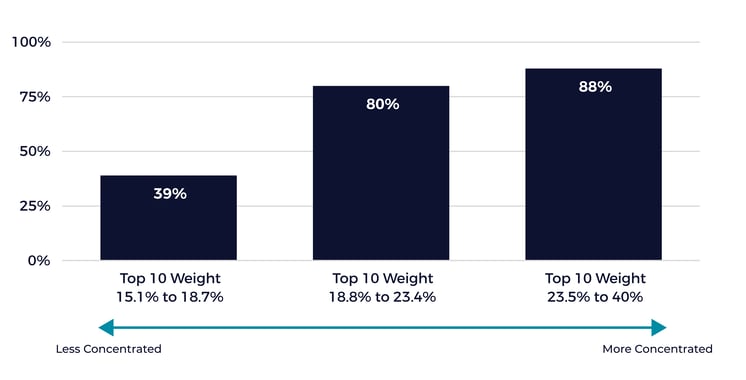
Periods of extreme concentration have often preceded phases of broader market leadership. When the top of the index becomes top heavy, the “catch-up” trade among the remaining constituents has been a durable feature of market cycles over the past 60 years.
A Top Heavy S&P 500 Usually Bodes Well for the Rest of the Index6
% of Periods When the Bottom 490 Stocks Outprformed the Top 10 Over the Next Five Years, by Market Concentration (1965-2024)
Source: CFA Institute, as of Feb 10, 2026.
The Problem with Equal Weighting—And the Historical Weight Solutions
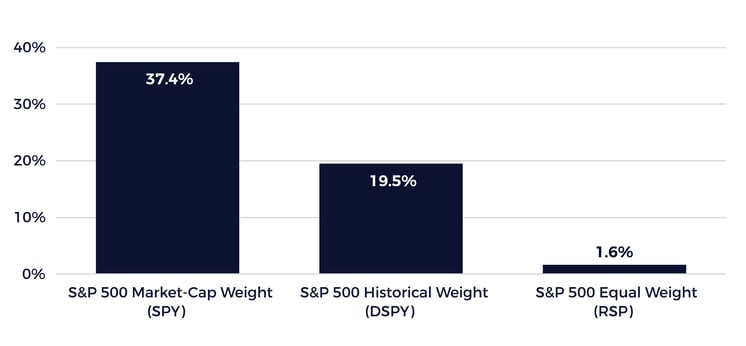
Investors concerned about concentration face a practical dilemma. Cap-weighted exposure has become increasingly top-heavy, but alternatives like equal weight introduce tracking error and sector drift. Equal-weighting gives each constituent roughly a 0.2% allocation, putting Apple on the same footing as the 450th-largest company and creating a sizable tilt toward the smaller constituents within the S&P 500.
A more nuanced approach, pioneered by Tema’s S&P 500 Historical Weight ETF Strategy (DSPY), anchors each position to its historical average weight. The result is a “Goldilocks” solution: Less concentrated than the cap-weighted S&P 500, without the distortions that come with equal weight. It recognizes that the index’s leaders are leaders for a reason, even if investors may not want them to dominate the portfolio.
An Equal Weight Strategy Excessively Dilutes Market Leaders
Cumulative Weight of the Top 10 S&P 500 Companies: Traditional Market-Cap vs. Historical Weights vs. Equal Weight7
Source: State Street Investment Management, Tema ETFs, and Invesco, as of Feb 5, 2026
Why it Matters for Investors
With concentration near record highs, the key question for S&P 500 investors is whether market leadership stays anchored in the largest stocks or broadens across the index. The Fed has begun easing financial conditions, and some measures of breadth are starting to improve, making the setup for broader participation look better than it has in years.
Over the long term, the S&P 500 has been a compelling investment because it offers a simple way to own the engines of U.S. innovation. But those engines evolve, leadership rotates, and the index periodically becomes more concentrated. In the past, such periods of elevated concentration have often been followed by multi-year stretches when performance broadened. Historical weighting is designed for that balance, deconcentrating the S&P 500 without overcorrecting or forcing a big style or sector bet.
For more of our research and recent insights, view and subscribe to our insights.