


Key Takeaways
-
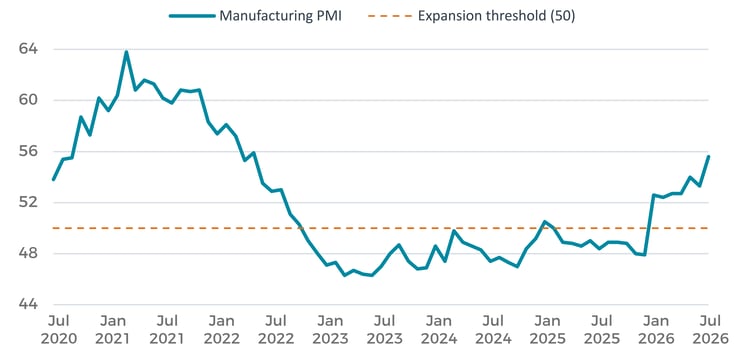
The ISM Manufacturing Purchasing Managers’ Index (PMI) reached 55.6 in July, its highest level since May 2022, reflecting a seventh consecutive month of expansion.1
-
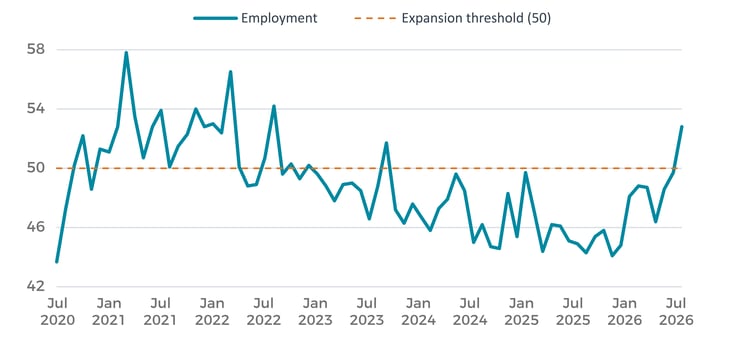
Importantly, its employment index also returned to expansion for the first time in 33 months, adding a very tangible signal to the improvement in survey sentiment.2
-
AI is becoming part of the industrial story, with investment in power generation, semiconductors, and emerging humanoid robotics translating into activity across factories, equipment, materials, and labor.
Amid an AI capex boom, record-setting IPOs, geopolitical conflict, and the run-up to midterm elections, an important U.S. economic story could easily get lost in these dog days of summer. The ISM Manufacturing PMI, a diffusion index in which readings above 50 indicate expansion, rose to 55.6 in July from 53.3 in June. That marked its highest level in more than four years and exceeded economists’ forecast of 54.0.1,3
We have written previously about investors looking to put a HALO around their portfolio. That rotation has often been framed defensively, as a hedge against concentration in the digital economy. ISM’s July data offers evidence that the physical economy is gaining momentum rather than simply holding its ground.
Seven Months In, and Broadening
The July report was not an outlier. Manufacturing has now expanded for seven straight months, marking a decisive break from a prolonged downturn that began after the sector peaked in 2021 and kept the PMI below 50 for much of the following three years. Four of the five subindexes that feed the headline PMI accelerated in July.3
U.S. Manufacturing Has Expanded for Seven Straight Months
ISM Manufacturing PMI, monthly (July 2020 to July 2026)
 Source: Institute for Supply Management, July 2026 ISM Manufacturing PMI Report
Breadth may be the more important development. Fifteen of eighteen industries reported growth in July. New orders rose and backlogs climbed, suggesting demand is pressing against current capacity. Export orders also returned to expansion, recording their highest level since March 2022.3
Customer inventories remained at levels that ISM characterizes as "too low" for the 22nd consecutive month, which bodes well for future production. Business inventories have also declined for five straight quarters.1,3
Hiring Is a Stronger Signal
One of the most notable lines in the ISM report was employment. The index leapt to 52.8, its highest level since August 2022 and its first expansionary reading in 33 months. In fact, sixty percent of panelists reported that their companies were hiring.3
Factory Employment Expanding for the First Time Since 2023
ISM Manufacturing Employment Index, monthly (July 2020 to July 2026)
 Source: Institute for Supply Management, monthly ISM Manufacturing PMI Reports. A reading above 50 indicates expansion.
Sentiment can improve on optimism alone, but plans to hire generally require greater confidence in the forward order book. Adding workers is one of the clearest signs that manufacturers expect the recovery to last.
Supply Pressures Are Increasing
Supply chain disruption continues to be a feature of the industrial landscape. Supplier deliveries slowed for an eighth straight month, while average lead times reached 172 days for capital expenditures and 87 days for production materials.³ Survey commentary reflected the same pressure: 62% of comments were negative, with pricing volatility cited in 57% of those comments, the Iran war in 43%, longer lead times in 22%, and tariffs in 18%.³ Together, these constraints reinforce the strategic case for more resilient domestic supply chains and continued reshoring.
“Competing for scarce supply — electronics, certain critical minerals and other categories — is challenging on-time fulfillment for our supply chains. This is expected to get worse with co-dependent sectors also remaining strong and restocking challenges for automotive electronics.”
– ISM survey respondent, Transportation Equipment³
Why This Matters for Investors
The July ISM report points to a manufacturing recovery gaining breadth, with stronger demand, accelerating production, low customer inventories, and factories adding workers. Elevated prices, longer lead times, and shortages remain constraints, but they increasingly reflect the strain of rebuilding domestic manufacturing capacity and strengthening supply chains as activity improves.
The AI buildout belongs on the list, too. ISM panelists described strong demand for semiconductors, advanced packaging, photonics, and power generation—all of which require factories, equipment, materials, and skilled labor. Rather than bypassing the industrial economy, AI is becoming an important customer of it.
For investors seeking exposure to this theme, the Tema U.S. Manufacturing & Reshoring ETF (WELD) invests in companies positioned to benefit from growth in domestic manufacturing, industrial activity, and infrastructure development.