


Key Takeaways
-
The data center buildout is accelerating, but long equipment lead times and grid connection delays remain critical bottlenecks.
-
Meanwhile, more efficient chips are fueling greater computing demand, while concerns over electricity bills and environmental impact are intensifying political opposition.
-
Behind-the-meter generation offers a faster path to power, creating opportunities across onsite generation, power equipment and natural gas infrastructure.
AI is synonymous with the data center buildout, which is happening across the U.S. Data centers are getting so large that some, like Meta’s Hyperion, are several times the size of New York’s Central Park.1
Data Centers Are Springing Up Across the Country
Map of U.S. data centers by published power (MW)
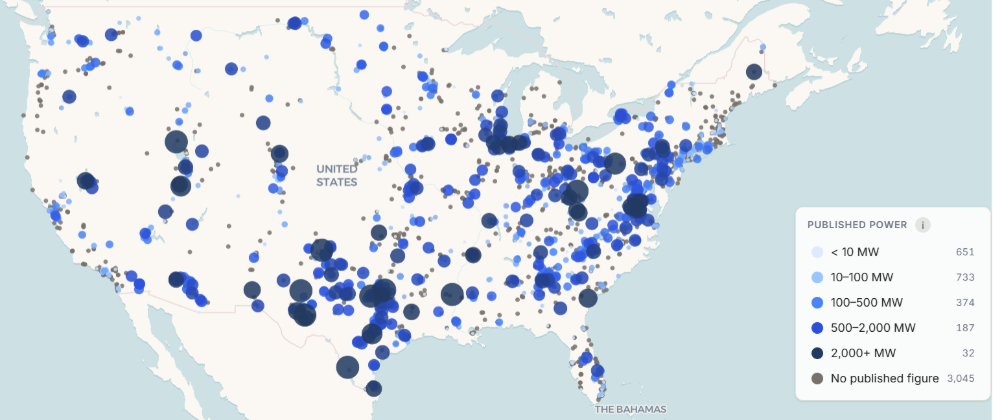
Source: US Data Center Map (dcmap.us), Oct 2026.
Constraints Everywhere
Yet building a data center is difficult, especially now. Lead times on everything have run up, particularly power equipment, widely seen as the most durable and long-term bottleneck.2
Power Equipment Can Take More Than Two Years to Arrive
Lead times for key data center power equipment, in weeks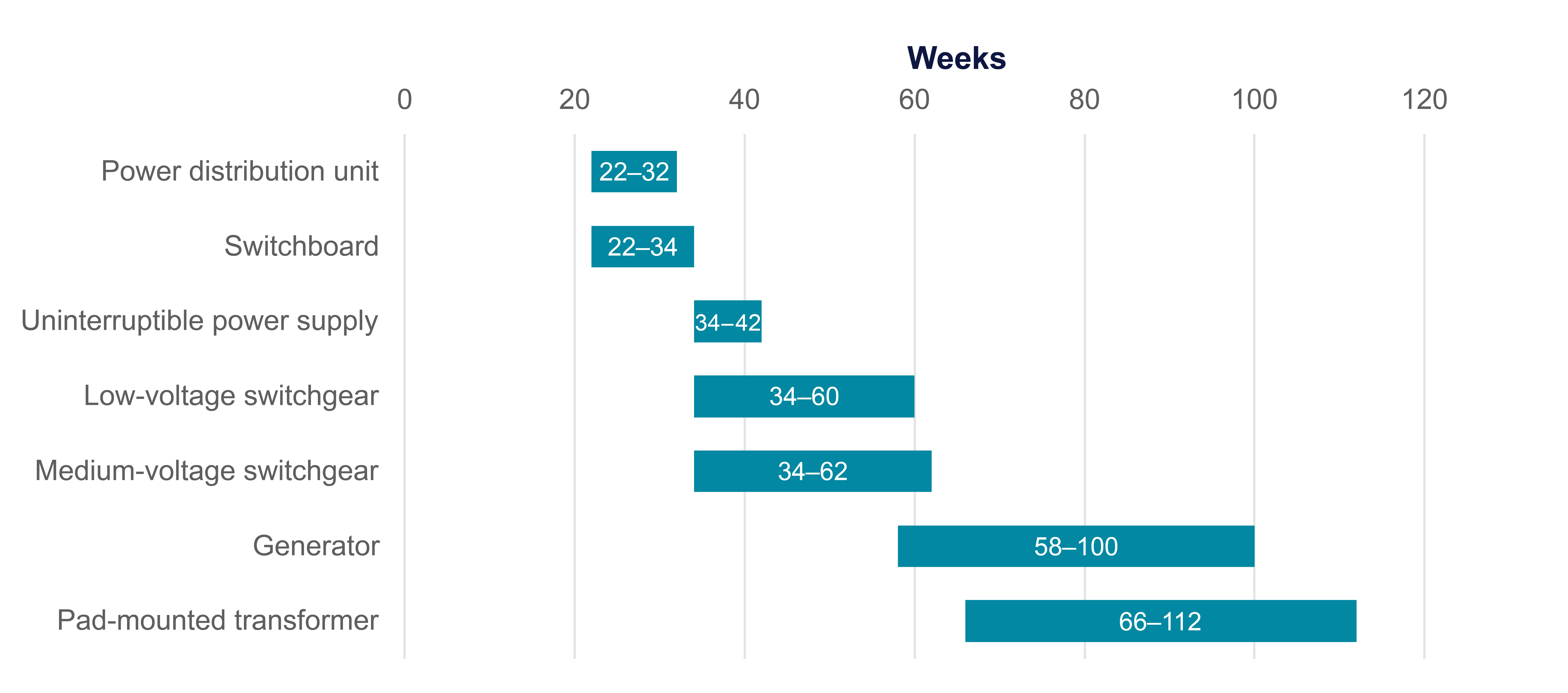
Source: Cushman & Wakefield and Hyundai Securities.
It isn’t just power equipment. Even connecting data centers to the power grid is taking longer and longer. The grid also faces a backlog of new supply: Nearly 2,600 GW of generation and storage capacity was stuck in the queue at the end of 2023, with typical waits exceeding four years for projects built in 2018-2023.3
Acute Need
Data centers are a valuable asset in today’s compute-constrained environment, so time to power is vital. SemiAnalysis estimates that the value of megawatts of compute is so high today that a power plant, estimated to cost $5 billion, could be matched by 20 days of inference revenue.4
There’s quite a crisis of power... I believe the consensus estimate among analysts who follow the AI space very closely is that there will be at least a 15-gigawatt shortfall of power in 2027 for AI chips. The rate at which AI chips [are] being produced has been rising incredibly rapidly. They’re rising on the order of 40 to 50 per cent a year. But power available outside of China has been rising at 10 per cent to 20 per cent a year. Obviously, the faster-rising thing will eventually overwhelm the slower-rising thing. - Elon Musk5
The shortage is acute and getting worse. Morgan Stanley estimates that, based on planned AI semiconductor sales forecasts, about 97 GW of power is needed in 2026-2028. Of that, 21 GW is already being built and has power, while another 19 GW can draw on the grid, leaving a whopping 57 GW gap before additional time-to-power solution.6
U.S. Data Centers Could Face a 57 GW Power Shortfall
Estimated cumulative power needs, available supply and potential shortfall, 2026-2028
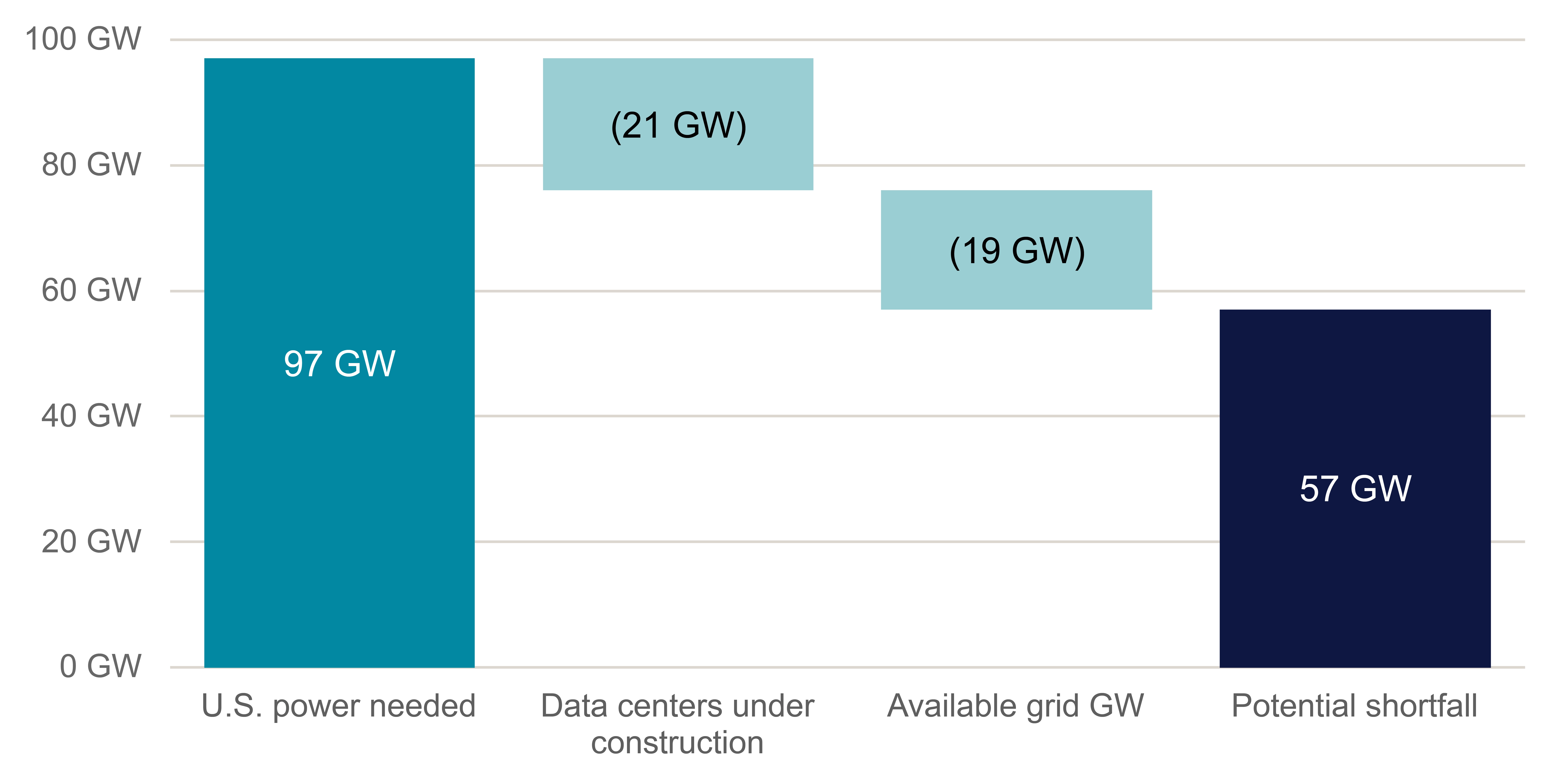
Source: Morgan Stanley, Sep 2026, via Financial Times.
To put this in perspective, that is the equivalent to the power consumption of roughly 10 New York Cities.6
New GPU Architectures Drive Even More Need
Things are also going to get worse, paradoxically from efficiency gains. The latest Nvidia architecture, Vera Rubin, produces up to 10x more inference throughput per watt than the Blackwell generation.7 Data centers are using these gains to deploy additional compute capacity rather than reduce electricity consumption. This is Jevons paradox in action: As efficiency saves costs, more is used, swamping the gains made from efficiency. The Feynman generation, scheduled to launch in 2028, will have even more power-dense racks. Morgan Stanley believes that this could drive a further 40% increase in U.S. data center power demand in 2029.6
Political Opposition Is a Risk
Political opposition to data center construction has become a growing obstacle. This is becoming a bipartisan issue, especially ahead of mid-term elections, and could slow the pace of data center construction.
In August 2026, Pew Research Center found that 54% of Republicans and 68% of Democrats would be uncomfortable with a new data center in their area. Half of Americans also say data centers are mostly bad for home energy costs, up from 38% in January.8 Concerns about electricity bills, environmental impacts, and quality of life are putting developers under pressure to show how local communities will benefit.
Public Concern About Data Centers Is Rising
Share of U.S. adults who say data centers are mostly bad for each area, Jan vs. Aug 2026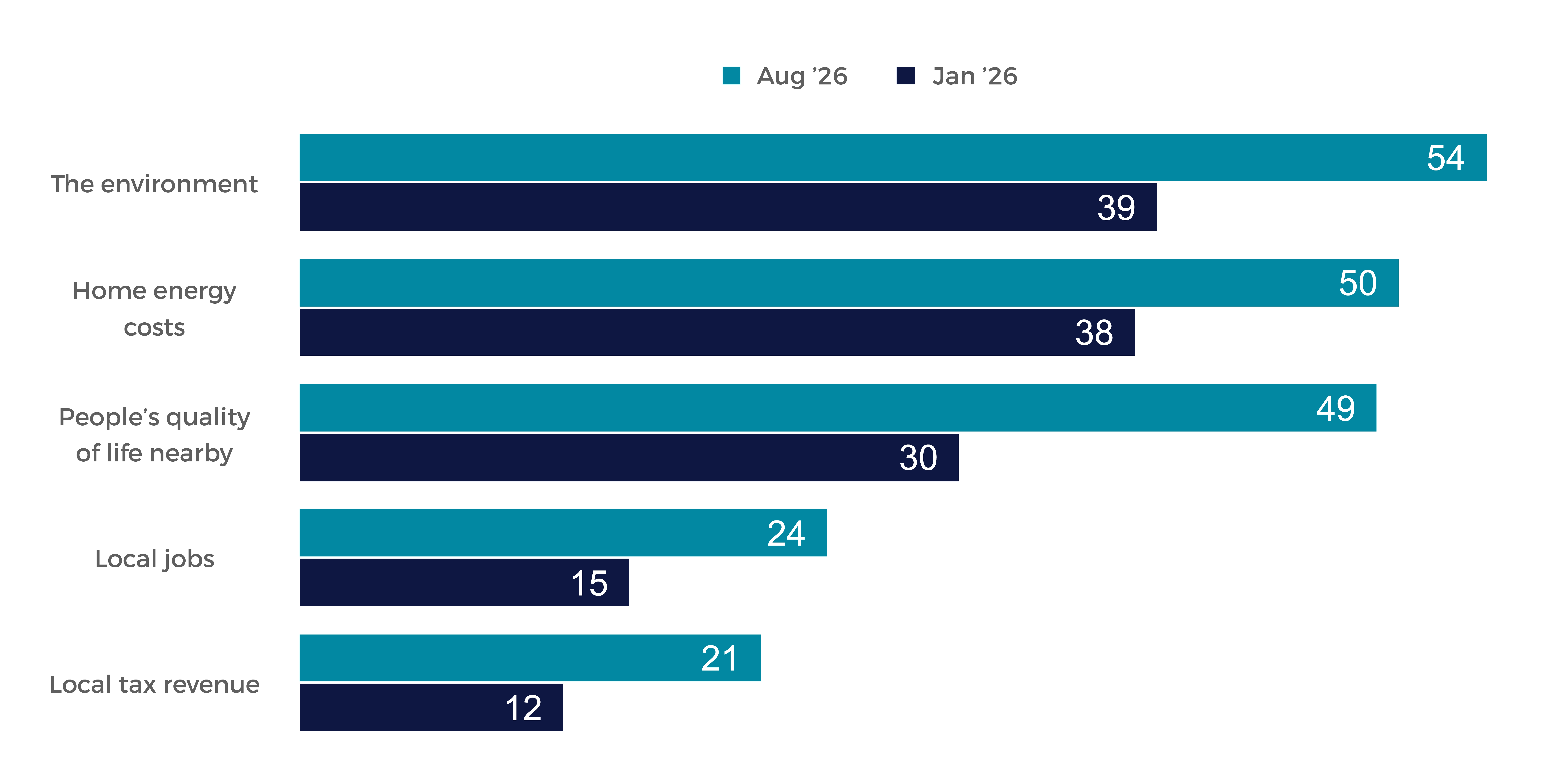
Source: Pew Research Center, Aug 2026.
Companies argue that data centers bring high-value jobs, including construction, helping upgrade the U.S. economy for the AI-led future. There is, in fact, evidence that data centers can lower electricity bills, although the impact depends on local conditions and supply constraints.9 It's a complicated matter.
The broader relationship between electricity demand and prices also challenges assumptions. According to a recent analysis, the largest price increases from 2019 to 2025 occurred in states where electricity demand fell.
Electricity Prices Rose Most Where Demand Fell
Demand growth by state vs. price change, 2019-2025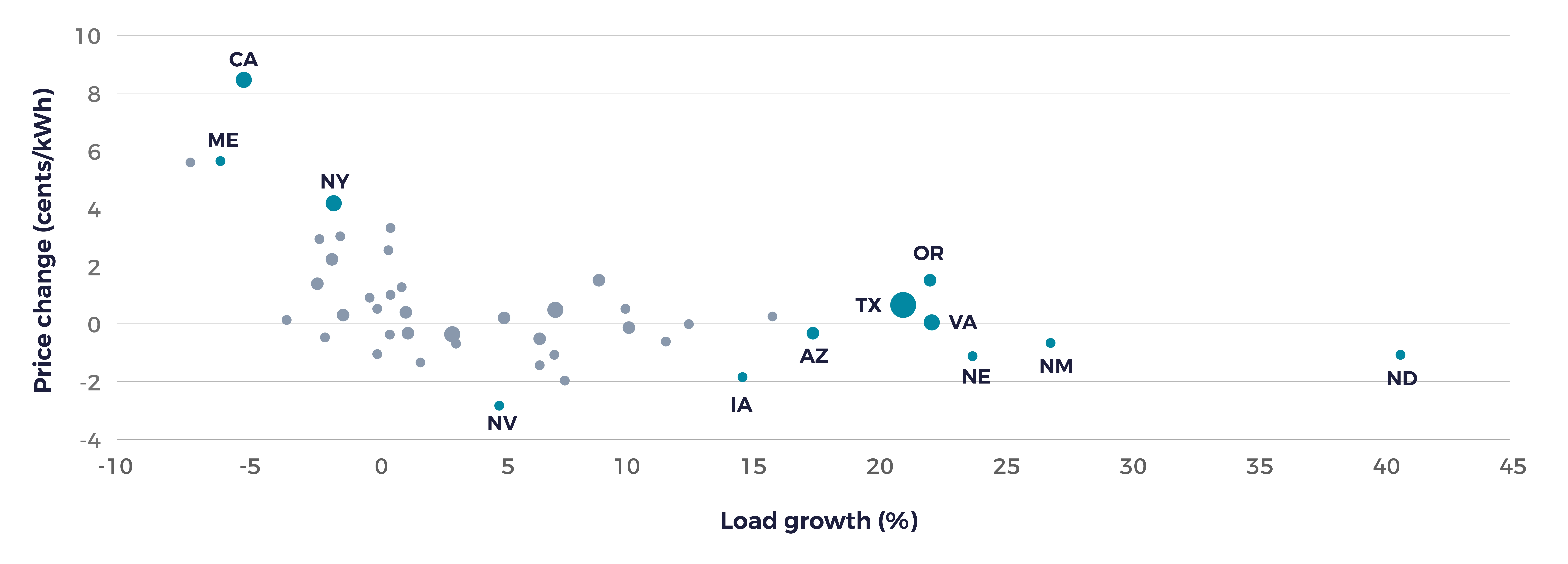
Source: Andreessen Horowitz, 2026.
Behind-the-Meter Power Is the Solution
The situation is forcing data centers to look far and wide for solutions behind the meter—meaning power generated onsite or supplied directly to the facility, with the fastest time to power. These solutions also reduce the perceived impact of data center construction on electricity bills, though this is disputed.
The need for power and the rising political opposition are leading to a boom in behind-the-meter power solutions. These include fuel cells, reciprocating engines, gas turbines, and other forms of power generation. Increasingly, these solutions also need gas piped directly to sites to provide power. Deals are getting upscaled and extended, with data centers signing 15-plus-year contracts for these solutions.4 SemiAnalysis believes that more than half of new U.S. data centers could be powered by behind-the-meter solutions from 2028 onward.10
Ultimately AI Power Is Geopolitical
Why does this all matter? AI is becoming a geopolitical flash point. BloombergNEF’s base-case scenario projects that China will add almost six times as much power-generation capacity as the U.S. over the next five years.11 The best AI models are developed by U.S. companies, but China has the grid capacity to run the infrastructure required.
Why It Matters
The data center buildout is creating an urgent need for power, with opportunities extending to the companies that generate it and supply the equipment required to deliver it. We believe these businesses could be among the most underappreciated beneficiaries of the AI boom.
The Tema Electrification ETF (VOLT) offers actively managed exposure to this opportunity.