


Key Takeaways
-
U.S. electricity prices have risen sharply after a long period of relative stability, reflecting a power system under new strain rather than a singular policy failure.
-
The main shift is structural: Demand from data centers, AI, and the reshoring of manufacturing is rising faster than supply can respond.
-
For investors, the broader implication is clear: A more power-hungry economy will require substantial new investment across the grid.
Why Are Electricity Prices Rising?
The last few years have seen a sharp rise in U.S. electricity prices, up 35% since 2020 after nearly a decade of relative stability. Last year alone saw a 5% increase, with some states seeing far larger moves,1 including double-digit increases across parts of the Northeast and Midwest.
Electricity is a meaningful household expense, making it part of the broader affordability debate ahead of the upcoming midterm elections. So what is driving the move higher?
Average Price: Electricity per Kilowatt-Hour in the U.S. City Average
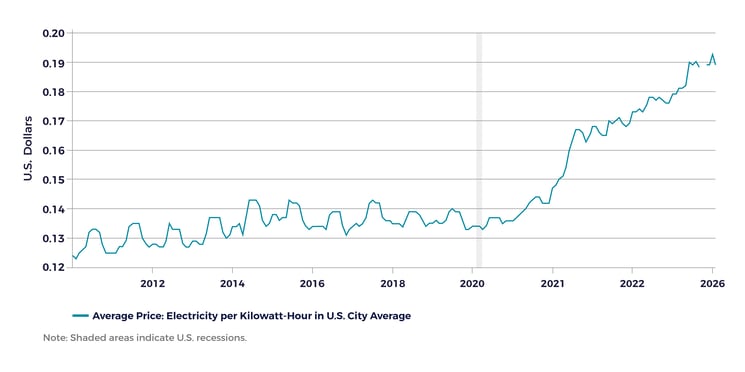
Source: US Bureau of Labor Statistics via FRED®, as of Mar 2026
Electricity Demand is Rising—and Supply Needs to Catch Up
The backdrop to these price increases is a fundamental shift in electricity demand. U.S. power demand is rising for the first time in decades and is forecast to grow 78% by 2050.2 The main drivers are not households, but data centers, AI, manufacturing reshoring, and electric vehicles. That growth in demand is now colliding with constrained supply, sending a clear signal that the U.S. needs more investment in electrification infrastructure.
Electricity Prices Are Driven by More Than One Factor
While there has been no shortage of claims about what is pushing electricity prices higher—including data center growth and clean energy deployment—no single factor explains the move.
Prices are shaped by a mix of supply and demand, wholesale market dynamics, and regulation, all of which vary across the country. In some regions, the capital costs of major infrastructure projects, such as new power plants or transmission upgrades, can be folded into the base rate through state utility regulation. Natural gas prices also matter enormously, because gas-fired generation sets the marginal price in most regions during most hours.3 Those costs are then passed through to consumer bills, often with some smoothing by regulators.
It is also worth remembering that U.S. household electricity prices remain low relative to much of the rest of the world.
Household Electricity prices worldwide in June 2023, by Select country (in US dollars per Kilowatt-hour)
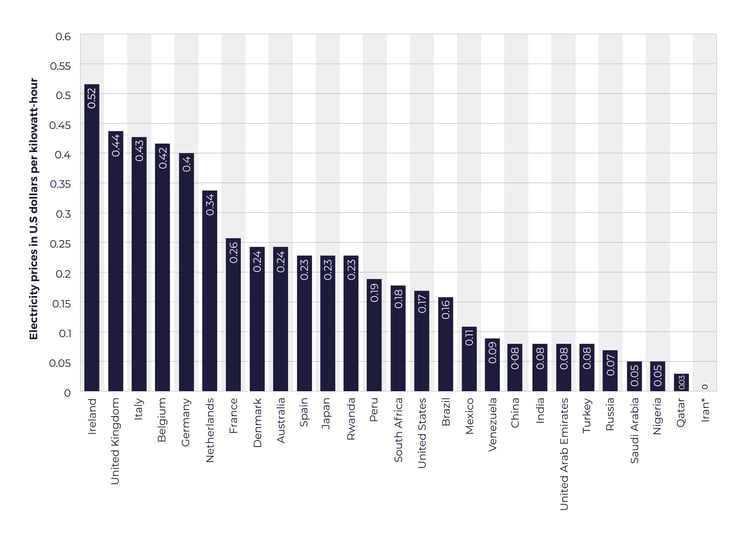 Source: GPP, as of 2024
Data Centers Are Trying to *Solve* the Problem
Data centers have become a major target of local frustration around rising electricity prices. These facilities consume enormous amounts of power and are increasingly being built at gigawatt (GW) scale. One GW is equivalent to powering roughly 400,000 homes. In some states, such as Virginia, data centers are consuming nearly 40% of all electricity.
Though attempts have been made4 to measure the data center boom’s impact on retail electricity prices, the answer remains complicated. The more important point is that the companies building these facilities are increasingly trying to solve the problem themselves by securing their own power, thereby reducing potential pressure on retail prices. They are largely doing this in two ways:
-
Bring your own power: With grid hook-ups in some cases taking several years, data center developers have increasingly turned to dedicated power sources. These include natural gas-fired reciprocating engines, dedicated renewable power such as solar or wind paired with battery storage, and fuel cells that use a chemical process to convert natural gas into power.
-
Bid to build your own power: PJM, the largest grid operator in the U.S., has, under government pressure, produced a plan to allow utilities to auction future power plants directly to data center companies. This is a major break from the past, effectively allowing data centers to pay for new generation that is built and connected to the grid on their behalf.
Why It Matters
Headlines can be misleading. The truth is that electricity prices are shaped by a range of factors, not a single culprit. Even so, they have become a focal point in the affordability debate with midterm elections looming. The clearest takeaway is that the U.S. needs more investment in generation, transmission, and distribution—and that data centers may end up funding part of that buildout directly.
How to Invest in the Theme
The Tema Electrification ETF (VOLT) invests in companies positioned to benefit from rising electricity demand and the buildout required to meet it, spanning grid and power equipment, utilities, nuclear, and alternative energy.
For more of our research and insights on electrification and more, view and subscribe to our insights.