

AI is driving one of the largest infrastructure buildouts in technology history. While much of the focus has been on AI chips, a more immediate constraint is emerging: The ability to move data fast enough to keep those chips fully utilized.
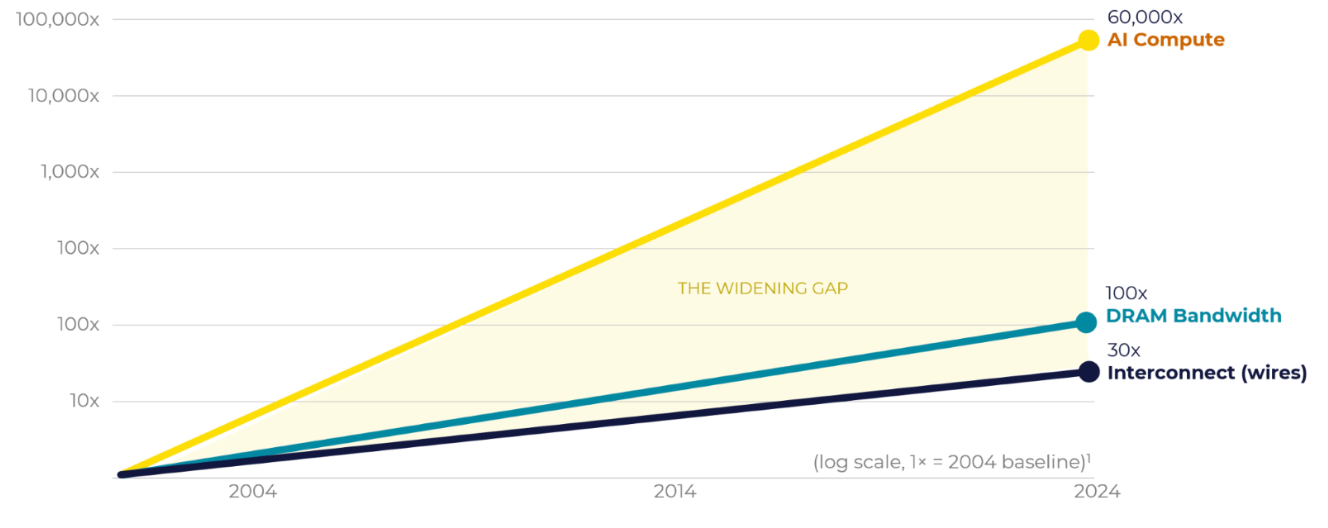
As AI systems scale, performance is shaped not just by how much data can be processed, but by how quickly it can move between chips, servers, and data centers. Increasingly, computing power is outrunning bandwidth.
Why Data Movement Matters
Today, data centers rely on a mix of copper and optical connections. Copper remains common for short-distances, while photonic and optical technologies, which use light rather than electrical signals, are used over longer distances that test copper’s inherent limitations. But AI is beginning to disrupt that balance.
Bandwidth requirements are rising rapidly as AI clusters scale. Each new generation of processors increases compute capacity, but that compute only matters if the surrounding infrastructure can deliver enough data flow to keep it fully utilized.
AI's Growth Is Outrunning the Wires Moving Its Data
Compute vs. wire growth, 20-year scale gain
Source: UC Berkeley/ICSI, Gholami et al., 2024
End-point multiples (60,000× / 100× / 30×) reflect ~20-year scaling gains. Lines are illustrative, straight log-scale paths from a 2004 baseline, showing relative divergence rather than year-by-year data.
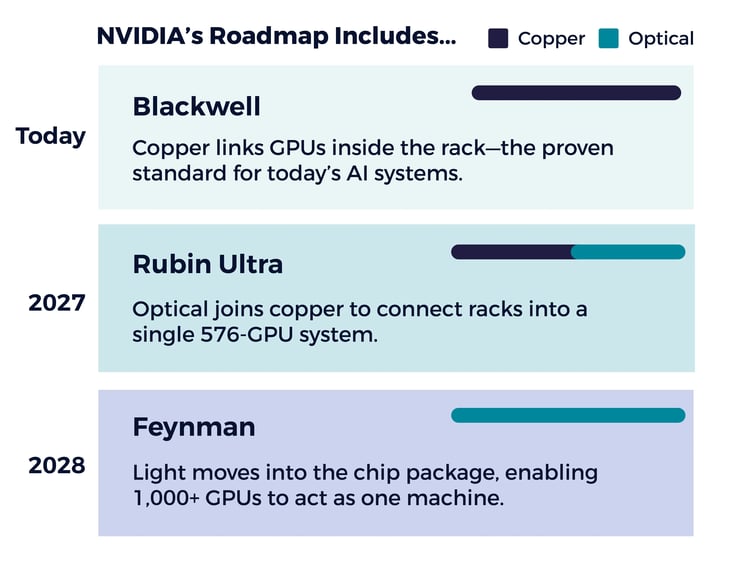
NVIDIA’s data center roadmap shows that this shift is already moving from theory to architecture. Blackwell, its current-generation AI platform, still relies primarily on copper links inside the rack, but Rubin Ultra, a next-generation platform anticipated in 2027, is expected to begin the transition by combining copper within racks and optical links between racks. By Feynman, system bandwidth requirements are expected to rise to more than four times today’s levels, with light moving deeper into the system to connect more than 1,000 GPUs.2 At that scale, copper may struggle to deliver the bandwidth, distance, and power efficiency required.
 Source: LABO LMM, Apr 2025
The Shift Is Moving Deeper Into the Data Center
The implications extend beyond faster links between systems. As more accelerators are deployed, the number of communication pathways increases, while newer architectures require more bandwidth per chip. At the same time, workloads are becoming more distributed across racks (groups of servers), data halls (large rooms of racks), and data centers, increasing the need for constant, high-speed communication.
Copper is constrained by limits in signal integrity, reach, and power efficiency, pushing optical technologies closer to the processor and deeper into the data center.
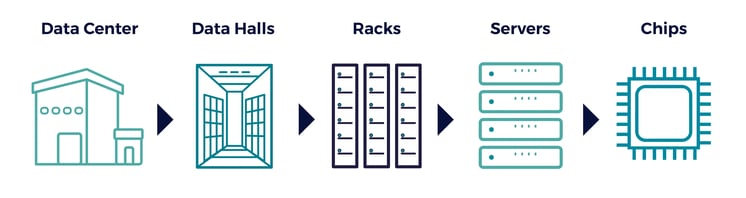 Illustrating hypothetical hardware and connections within a data center
A Potential 10x Market Expansion
Today, optical interconnects are used primarily between racks and data centers. If optics move into intra-rack connections, the addressable market could grow dramatically. Because shorter-distance links represent the majority of connection volume within data centers, a shift from copper to optics at that layer could expand the market opportunity by an estimated 10x over time.2
This shift is already visible in the roadmaps of NVIDIA and its peers. Increasingly, however, it is showing up in capital allocation, too. NVIDIA has committed $6.5 billion to photonics-related companies,3 including investments in leaders such as Coherent (COHR), Lumentum (LITE), Marvell (MRVL), and Corning (GLW(. In our view, these investments indicate that optical interconnects are becoming a strategic priority in next-generation AI infrastructure.
This shift is less about a single product cycle and more about a foundational change in how AI systems are built.
Positioning for the Next Phase of AI Growth
As AI infrastructure scales, the ability to move data efficiently may become as important as the ability to process it. We believe photonics and optical interconnects represent a key, and still underappreciated, investment opportunity in the next phase of AI growth.
The Tema Photonics & Optical ETF (LAZR) invests in global companies enabling this next phase of AI infrastructure. Through a high-conviction, actively managed portfolio, LAZR provides pure-play exposure to the photonic and optical technologies that are increasingly essential to scaling AI.