


Key Takeaways
-
HBM and DRAM were the first memory markets to reflect the AI bottleneck, with shortages sending prices sharply higher.
-
NAND is still often viewed as cyclical, but AI inference is creating new demand for high-capacity, lower-cost memory.
-
With NAND supply growth constrained and new architectures moving flash closer to the processor, NAND may be the next leg of the AI memory cycle.
For two years the AI memory trade has focused on HBM, or high-bandwidth memory. Investors learned to associate HBM with AI growth, while NAND flash—the technology behind solid state drives (SSDs)—was viewed as a cyclical commodity market best avoided.
That view now looks outdated.
NAND Is Becoming Part of AI compute
AI systems rely on a hierarchy of memory. HBM sits closest to the GPU, dynamic random-access memory (DRAM) provides additional working memory, and NAND flash has traditionally served as storage.
When a model processes a prompt, it builds a key-value (KV) cache: The working context that grows as a conversation or task becomes longer. Context is effectively the working memory that is held by a large language model (LLM). Long-context and agentic workloads can quickly exceed what HBM and DRAM can efficiently hold, which means more of that context is increasingly offloaded onto high-capacity NAND SSDs. Context memory is a scarce resource—and one that can matter as much as GPU utilization.
At GTC 2026, NVIDIA embraced this architecture by designing AI systems that offload inference context to large pools of shared flash storage. This effectively creates a new memory tier between the GPU and traditional enterprise storage, with massive amounts of flash supporting a growing share of AI workloads. What was once considered "storage" is becoming essential infrastructure for AI inference.
The Next Step: Flash Moves Closer to the Processor
The next step may be even more significant. Companies including SanDisk and SK Hynix are developing High Bandwidth Flash (HBF), a new architecture that stacks NAND in a form factor similar to HBM and places it much closer to the processor.
The promise is compelling: Substantially higher capacity at a fraction of the cost of HBM, while delivering sufficient performance for many inference workloads. The technology remains early-stage, but it highlights how NAND is increasingly being considered alongside traditional memory technologies rather than apart from them.
The Economics Favor NAND
DRAM is capacity-constrained and expensive. HBM is even more so. Flash is an order of magnitude cheaper per bit.
As AI agent system generate far more tokens than human-driven interactions, keeping more context on lower-cost NAND improves unit economics. That demand is already becoming visible: A single NVL72-class rack is estimated to require 1,152TB of NAND.1
Supply Is Tightening Just as Demand Builds
NAND demand is strengthening against constrained supply growth. A key reason is capital allocation. NAND production competes for the same clean room space and investment dollars as HBM and DRAM. Samsung and SK Hynix have been steering capital toward HBM and server DRAM, where margins are highest, while NAND capex has increased only modestly.2
With limited new clean room space, much of today’s NAND capex is going toward upgrading equipment and hybrid bonding, rather than greenfield capacity. New fabs are not expected to meaningfully add supply until the second half of 2027 or 2028.
As a result, NAND supply growth is forecast at around +17% per year, well below the historic range of 20-30%.3 For the first time this cycle, NAND quarterly contract price increases in Q2 2026 are outpacing DRAM’s.4 NAND flash revenue alone is forecast to reach nearly $150 billion in 2026 and exceed $175 billion in 2027.5
AI Is Driving Explosive NAND Demand
NAND flash market revenue, $bn
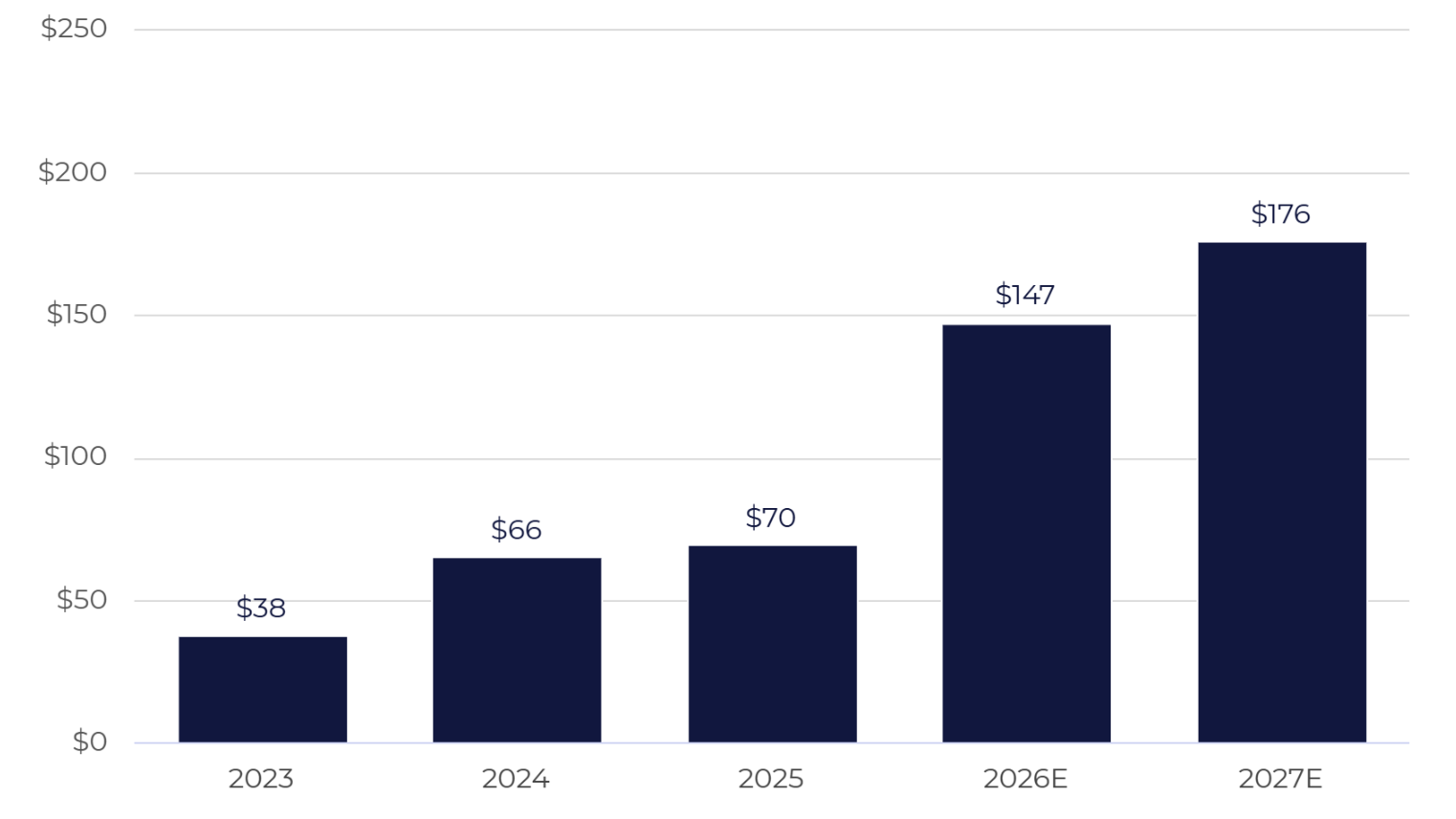 Source: TrendForce, Jan 2026
The Bottom Line
The market still tends to view NAND through the lens of its past: A cyclical storage product vulnerable to oversupply. But AI may be changing that narrative. As models become larger, contexts become longer, and AI agents become more prevalent, NAND is evolving into a critical component of the AI memory stack. Rising demand, constrained supply growth, and improving pricing dynamics create a setup that looks increasingly attractive.
The next phase of AI may require far more than GPUs and HBM. It will also require vast amounts of affordable memory capacity. NAND is emerging as a key enabler of that shift. For investors, the opportunity may lie in recognizing that NAND is becoming a more important part of how AI systems operate. By tilting toward NAND, the Tema Memory ETF (DISK) is built to capture a sizeable—and growing—part of the memory market that may be underappreciated relative to its fundamentals.