


Key Takeaways
-
Anthropic has emerged as the leading enterprise AI lab, with ARR multiplying from $9 billion in December 2025 to more than $75 billion by July 2026.
-
Claude Code is a major growth engine, monetizing a high-value workload where usage-based pricing ties AI spend directly to software-development productivity.
-
Heavy investment in frontier-model training masks otherwise attractive business economics, and SemiAnalysis sees a clear path to profitability as the business scales.
What Is Anthropic?
In 2021, seven former OpenAI researchers and executives left to start a new AI frontier lab: Anthropic. The group included Dario Amodei, OpenAI’s former VP of research, and Tom Brown, who led engineering work. Brown, along with co-founders Jared Kaplan and Sam McCandlish, authored the seminal paper on scaling laws–the observation that model performance improves as compute, parameters, and training data increases.1
Today, Anthropic is the leading AI lab and the creator of Claude, its family of large language models named after Claude Shannon, the father of information theory. Claude powers products including Cowork and Claude Code, helping Anthropic build a leading position in the enterprise market. The firm generates nearly $75 billion in annual recurring revenue (ARR), built on top of vast computing resources used to train new models and inference existing ones.2
A Research-Led Operating Base
Anthropic was built on a culture of research and intellectual rigor. The company has reportedly maintained a low 8% staff turnover rate, an important advantage in a field where scarce technical talent matters.3 More importantly, its early research anticipated where the industry was heading: larger models, reasoning, and agentic systems.
This research core has been complemented by an experienced executive team focused on turning technical leadership into high-value products. Claude Code, for example, created an exceptionally high-value workload. Coding agents can consume far more tokens than conventional chatbots because they repeatedly inspect files, write code, execute tests, and correct errors. The customer is willing to tolerate a meaningful bill because the comparison is not with a search-engine query; it is with the cost of software-engineering time. In Europe and North America alone $600 billion per year is spent on software developer salaries.3
Growth Outlook
Anthropic’s revenue has scaled at a near unprecedented pace. In December 2025 their ARR was just $9 billion–and by July 2026 it had reached over $74 billion.4 Some estimates suggest the run rate passed $80 billion in July and could reach $100 billion if the current trajectory continues.5
Anthropic's Annual Recurring Revenue, $Bn1
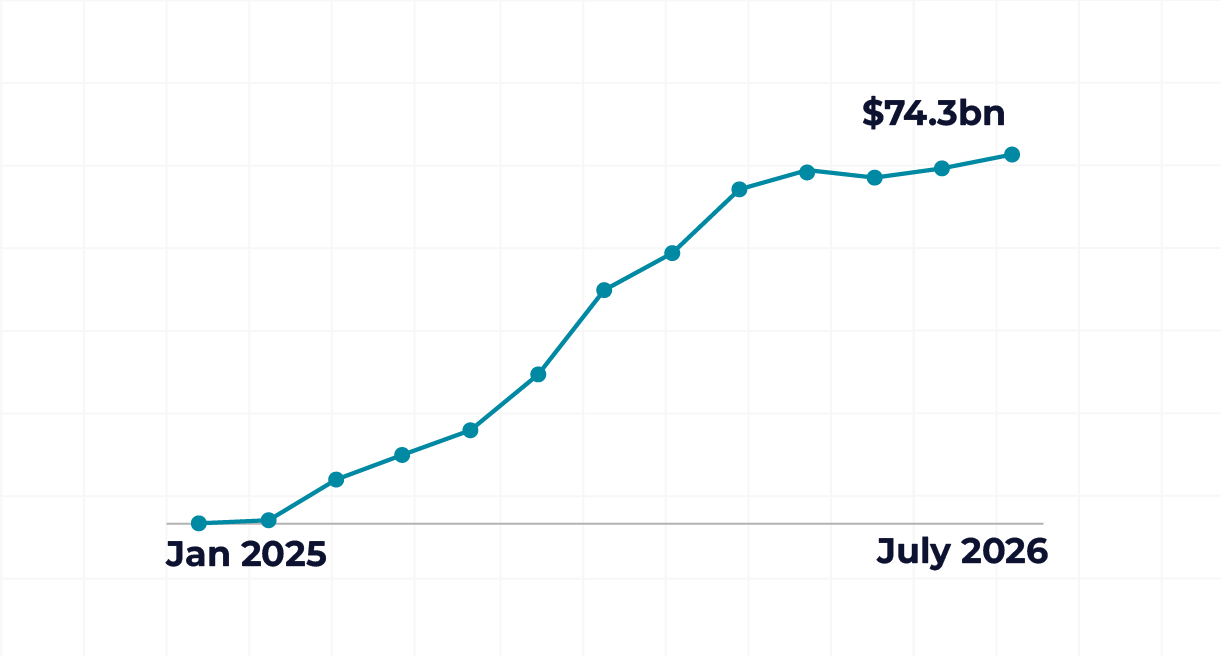 Source: TickerTrends Research, July 23, 2026
Much of the acceleration has been driven by Claude Code and its usage-based pricing. SemiAnalysis estimates that 85% of Anthropic ARR is usage-based APIs. Claude Code was a true revolution for software developers and reportedly accounts for 7% of all GitHub commits.4
How Anthropic’s Business Works
The frontier lab model has three core components:
-
New model training and development to push the frontier of intelligence. Anthropic’s latest models are becoming so powerful that more safeguards are being placed for cybersecurity. Training new models is very expensive as it requires massive computing power.
-
Running inference for customers across B2C and B2B use cases. This is where AI labs monetize models through subscriptions or usage-based pricing, typically measured per token.
-
Expanding vertically into sectors such as Claude for Financial Services, Healthcare, Science, and Cybersecurity. Anthropic is also building an AI services company together with PE firms Blackstone and Hellman & Friedman, helping push AI adoption and inference demand deeper into knowledge industries.
One of the key misconceptions in the market is that while overall profits may underwhelm, much of that is because spending is being invested in training. By contrast, inference is very profitable–with gross margins nearing 60%.
The Economics of AI Inference and Training
AI market economics – industry income statement
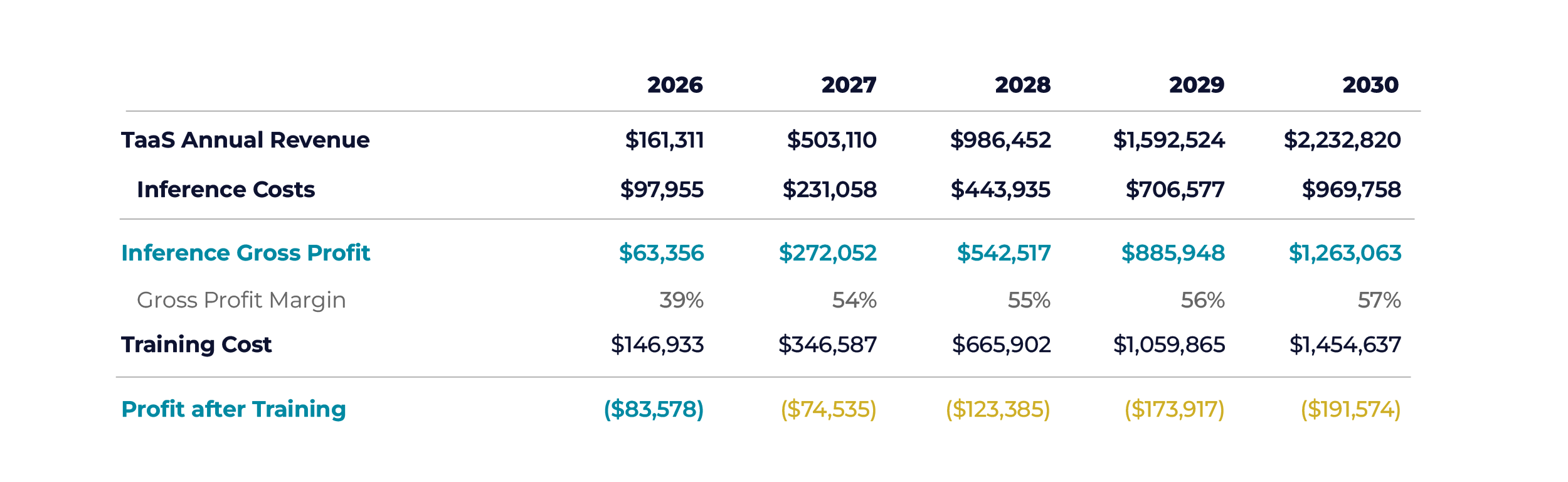 Source: SemiAnalysis
Balance Sheet and Path to Profitability
Anthropic appears better positioned than the broader industry because of its B2B revenues and enterprise leadership. SemiAnalysis estimates the business could reach non-GAAP profitability by Q3 2026 and potentially generate $1 billion of earnings before interest and taxes (EBIT).
Anthropic has raised roughly $100bn in capital since inception. Most of this capital has been directed at training frontier models. If profitability is indeed achieved, it will likely help improve cash burn and move the company toward positive cash generation.
“Anthropic’s capital position is strong. With over $100B raised, a profitable business model, and strong gross margins.”
– SemiAnalysis4
Valuation Case
We can frame Anthropic’s valuation in a few ways:
-
Anthropic's May 2026 financing valued the company at $965 billion,6 or roughly 18x its then-estimated $54.6 billion ARR.2 If ARR approaches $100 billion, the same multiple would imply a valuation of about $1.8 trillion.
-
The only two listed AI labs, China's MiniMax and Z.ai, trade at roughly 14x to 30x sales.7 Applied to $100 billion of ARR, that range would imply roughly $1.4 trillion to $3 trillion.
-
Looking further out, SemiAnalysis estimates Anthropic could reach $300 billion of ARR by the end of 2027.4 At a 20x sales multiple, broadly in line with the latest private round, that would imply a $6 trillion valuation.
The Bottom Line
Anthropic is a unique company, boasting strong fundamentals and an unprecedented growth trajectory. For investors seeking pre-IPO exposure, the Tema Photonics and Optical ETF (LAZR) holds a 2.44% position via an SPV in this transformational company, as of Aug, 17 2026.