

Key Takeaways
-
AI infrastructure is not just expanding—each new generation of AI hardware is becoming dramatically more power intensive, increasing the need for components that store, regulate, and convert electricity.
-
MLCC demand for AI servers could rise 5x by 2027,1 as higher power requirements increase capacitor content and collide with constrained supply.
-
The shift toward 800V DC power architectures could drive power semiconductor content up 12x from roughly $9,500 to $115,000 per rack,2 creating another potential beneficiary of the AI infrastructure buildout.
Delivering AI requires a vast amount of computing infrastructure. By some estimates, this is as much as a $7 trillion investment cycle, requiring a wide range of critical components.3 GPUs are the best known. Less appreciated are two components essential to powering them:
-
MLCCs: A small electronic part that stores and releases electrical energy in a circuit. A multi-layer ceramic capacitor (MLCC) stacks multiple internal ceramic and electrode layers to enable superior performance in a smaller package.
-
Power Semiconductors: A specialized electronic component designed to handle, control, and convert large amounts of electrical voltage and current in power systems.
The fundamental demand for these components stems from the fact that Moore’s Law has come to an end. Moore’s Law states that the number of transistors on a chip doubles every two years—largely achieved through shrinking the size of transistors. As compute requirements grow faster than transistor scaling can keep pace, power needs are rising, driving demand for MLCCs and power semiconductors.
AI Data Center Deployment Is Accelerating
By 2030, projected AI data center capacity could approach 1,000 GW, more than doubling in just six years.4
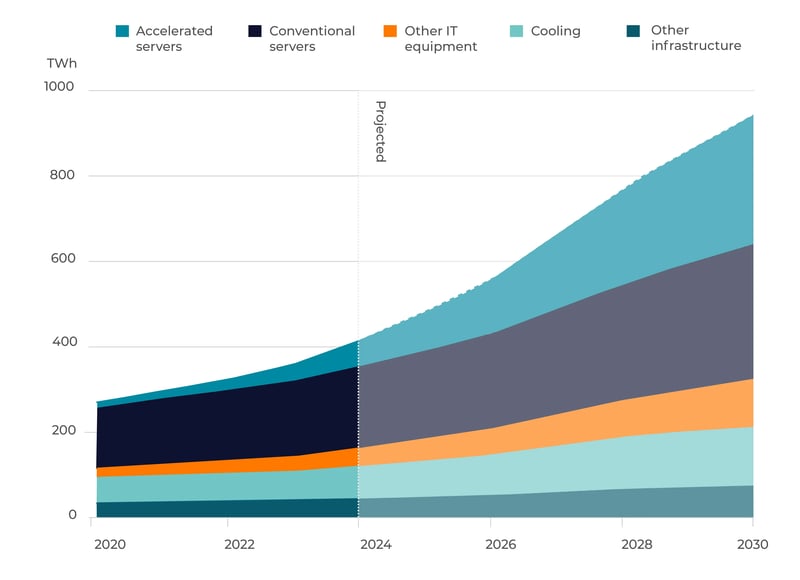 Source: IEA, Apr 2026
AI Server Racks Are Becoming More Power-Dense
Power density continues to rise with each new NVIDIA generation. The upcoming Rubin generation, for example, is expected to deliver roughly 6x the power density of the 2022 generation, Hopper.5
GPU Rack Power Density
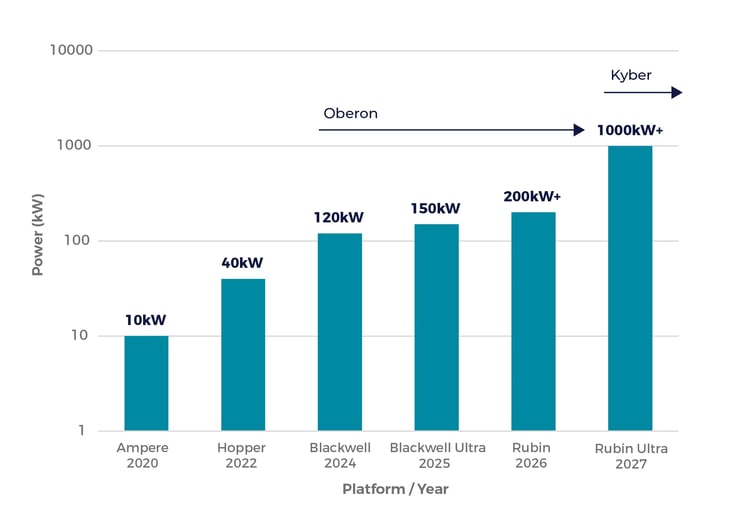 Source: NVIDIA, Deutsche Bank, Jun 2026
MLCCs: Small Components, Growing Demands
Every AI accelerator needs tens of thousands of capacitors around the processor and power-delivery circuitry to smooth voltage, suppress noise, and provide instantaneous current. Yet MLCC demand doesn’t just track the increase in AI server shipments. AI servers consume a large amount of power instantaneously, so to maintain operations it is necessary to temporarily store this power. As accelerator power rises, so does the required capacitance, while limited board space increases demand for higher-end MLCCs. Murata estimates that capacitor content could rise from 10,000–20,000 per server to 15,000–25,000.
The forecasted demand for MLCCs could rise 5x by 2027.1 This surge is confronting tight supply—as historically MLCCs did not see much growth and hence lacked investment by suppliers. New production lines take two years to build, while lead times have stretched to 36 weeks from just two weeks before the AI buildout began.6 AI also demands more complex products, which are harder to manufacture. The result is rising prices for these components benefitting manufacturers.
Power Semiconductors: The Shift to 800V DC
The power densities of AI racks are rising to such an extent that they are forcing a rethinking of the entire power architecture.
Alternating current (AC) was established as the dominant architecture for power 100 years ago. In data centers, power is drawn from the grid all the way to the microprocessor. Crudely, this process involves multiple steps of stepping down voltage and converting several times from alternating to direct current (DC) and back. Each step involves some power loss, with AC-to-DC conversion alone losing roughly 5-10% in the form of heat.
Once racks reach 200-300kW (kilowatts = 1,000 watts) this process becomes very inefficient. The solution is to re-architect the data center around 800V DC, reducing conversion steps, heat and power loss, while improving efficiency and using less copper. For example, a 1MW (megawatts = 1,000 kilowatts) rack would require 200 kg of copper, meaning a 1GW (gigawatts = 1,000 megawatts) data center could require approximately 200,000 kg of copper.7
800V DC is still being developed, with adoption likely beginning by 2028. Regardless, the need for power means intermediate architectures will be implemented. Ultimately, to deliver 800V requires a huge increase in the power semiconductor content from $9,500 per rack today to an estimated $115,000 per rack or 12x.2
AC vs. DC Data Center Comparison: Efficiency & Infrastructure
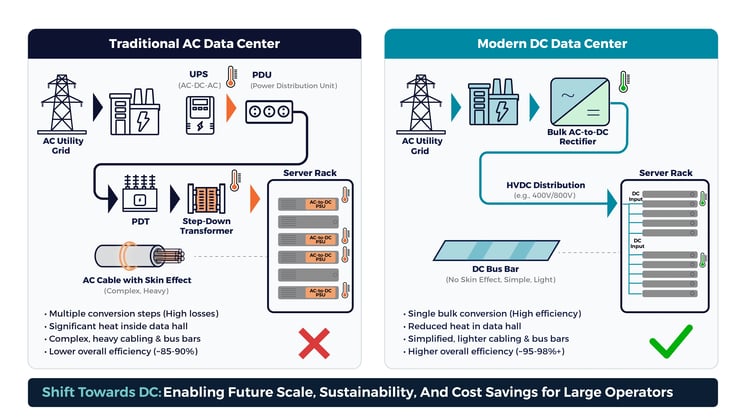 Source: The Fusion Report, Deutsche Bank, Jun 2026
The Overlooked Power Behind AI
The AI investment story extends well beyond GPUs. As data centers become larger and more power intensive, the amount and sophistication of the components required to manage that power are rising alongside them. MLCCs face the combination of rapidly increasing AI demand and constrained manufacturing capacity, while the evolution toward 800V DC architectures is poised to dramatically increase power semiconductor content per rack.
The Tema MLCC & PowerSemi ETF (PSOX) invests in companies supplying these two critical components of AI infrastructure. For investors looking beyond the most visible beneficiaries of AI, PSOX offers targeted exposure to the companies helping make the next generation of increasingly power-hungry AI systems possible.