


Key Takeaways
-
Enthusiasm for the space economy has cooled since SpaceX's IPO, but the long-term outlook is strong.
-
Lower launch costs, rising launch demand, and expanding profitability continue to strengthen the case for space.
-
As commercial and government investment accelerates, growth across the space economy remains supported by powerful secular trends.
SpaceX's Starship is on the cusp of its 14th launch. The mission is expected to mark the rocket's first trip to orbit while deploying Starlink V3 satellites designed to expand global connectivity, a topic we explored in August.
Yet the mission arrives at an interesting moment. The exuberance surrounding SpaceX’s June IPO has subsided, and many space stocks have retraced a significant portion of their gains from earlier in the year.1 But while share prices have pulled back, the industry's underlying fundamentals continue to show promise. Five trends help explain why the recent pullback may represent an opportunity to revisit space.
1. The Cost of Reaching Orbit Keeps Falling
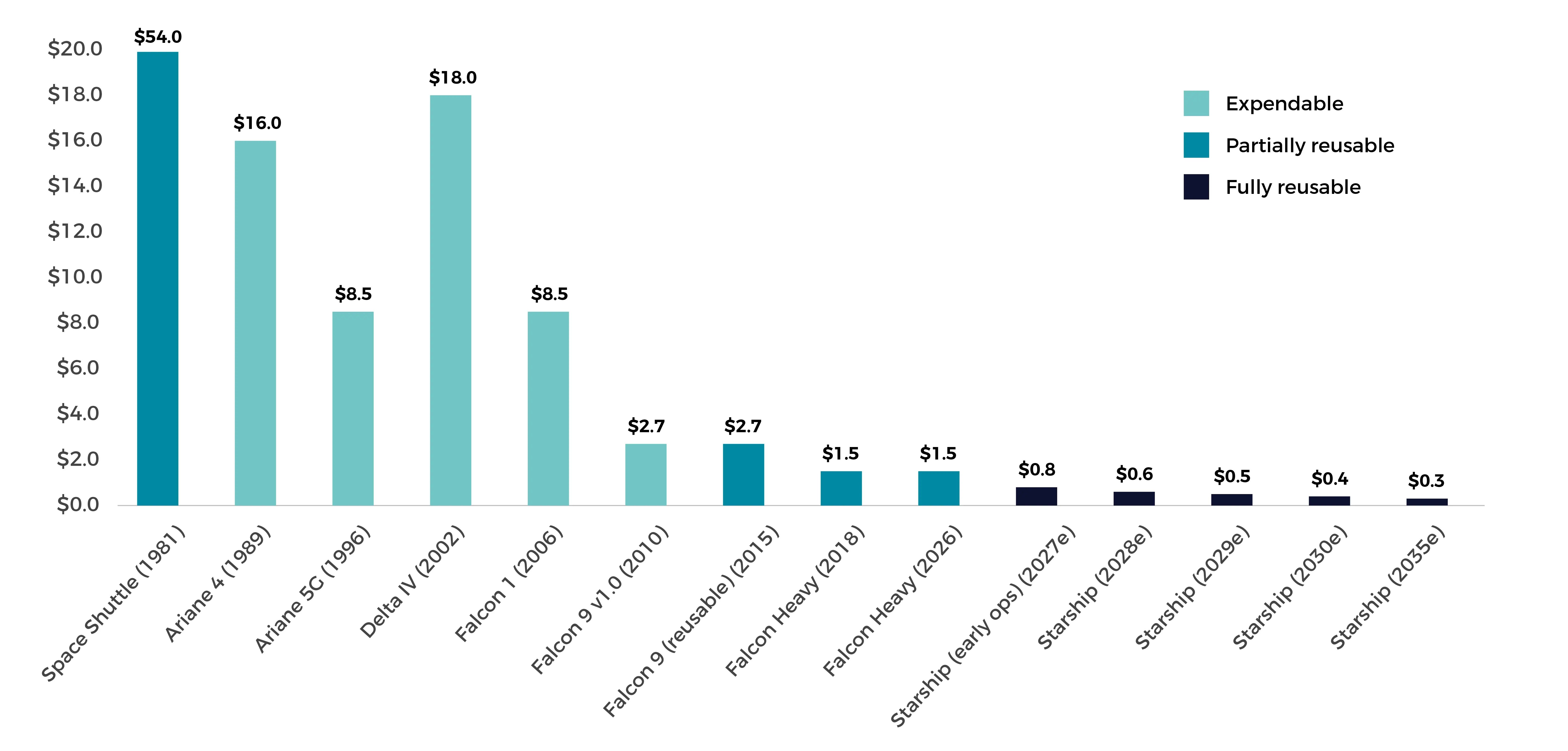
The next phase of the space economy may be driven less by incremental improvements and more by a step change in launch economics. SpaceX estimates Starship could eventually reduce launch costs to below $100 per kilogram (kg), compared with roughly $2,700/kg for Falcon 9 today.2
Lower Launch Costs Can Expand the Space Economy
Launch cost per kilogram, ($k)
 Source: Berenberg, "Aerospace & Defence: More Than a Moonshot," Sep 2026
Equally important, Starship is designed to support substantially higher launch cadence, with planned Starlink deployments suggesting launch rates could reach roughly one mission every two weeks beginning in 2027.3 Lower costs combined with higher launch volume could accelerate satellite deployment, expand commercial use cases, and increase demand across the broader space ecosystem.
2. The Potential for an R&D Revolution
Lower launch costs are unlocking demand, and the market may be underestimating how much. We believe satellite launch volume can grow more than 40% annually through the end of the decade, driven by an estimated 40,000 satellites expected to be in orbit by then.4 SpaceX has already filed plans for another 100,000 Starlink satellites and up to 1 million satellites to support data centers in orbit,3,5 potentially making today's launch forecasts look conservative.
Every additional satellite requires manufacturing, components, launch services, and ground infrastructure. And as more satellites reach orbit, the benefits extend well beyond the rocket companies and across the broader space supply chain.
3. The Industry Is Becoming Profitable
Space companies have long been associated with heavy upfront investment and long paths to profitability. That’s beginning to change. Starlink is already generating EBITDA margins above 60%, according to recently reported SpaceX financials.6
But the trend extends beyond SpaceX. Planet Labs delivered its first year of positive adjusted EBITDA in fiscal 2026,7 BlackSky generated a 14.2% adjusted EBITDA margin in the second quarter of 2026,8 and ICEYE achieved an EBITDA margin above 40% last year.9
As more space companies turn profitable, the sector is taking shape as an established industry with proven business models and lasting commercial potential.
4. The Race to the Moon Is Back
More than 50 years after the last Moon landing, the U.S. and China are now racing to establish a sustained lunar presence. NASA is targeting a crewed Moon landing in 2028,10 while China aims to land astronauts by 2030.11 The country that establishes a sustained lunar presence could play a leading role in shaping the infrastructure, standards, and commercial activity that follow.
The renewed push to the Moon is creating demand for rockets, landers, communications systems, and other space infrastructure. Unlike the Apollo era, much of that hardware is being built by commercial companies, including SpaceX and Blue Origin.
5. Defense Budgets Are Moving Into Orbit
Satellites now underpin military communications, navigation, and threat detection, and governments are spending accordingly. Government space budgets worldwide have more than doubled since 2014.12 The U.S. administration, in particular, has requested $71 billion for the Space Force in fiscal 2027, a 123% increase from the prior year.13 Golden Dome, a proposed U.S. missile-defense architecture incorporating space- and ground-based systems, has been estimated by the Congressional Budget Office to cost $1.2 trillion over 20 years.14
Every Major Government Is Spending More on Space
Estimated global government budgets by country, ($bn)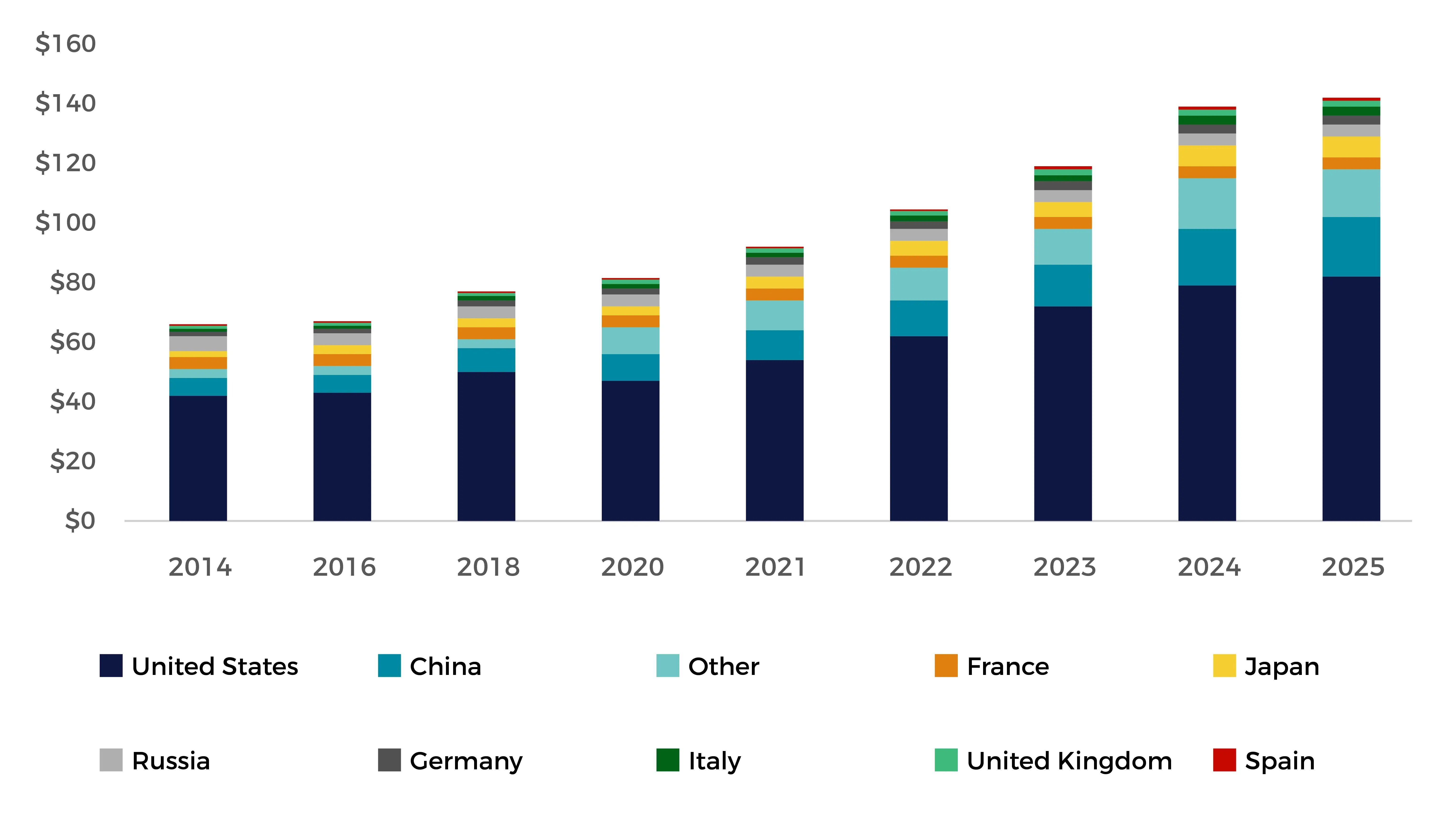 Source: Berenberg, "Aerospace & Defence: More Than a Moonshot," Sep 2026
As governments expand their space capabilities, a growing share of that spending is flowing to both commercial space companies and their suppliers.
Sentiment Has Reset, But the Investment Case Hasn't
Falling launch costs, accelerating launch demand, expanding profitability, and rising government spending commitments all point in the same direction. While investor enthusiasm has cooled, the fundamental drivers underpinning the space economy are compelling.
For investors looking to gain exposure to these trends, the Tema Space Innovators ETF (NASA), the largest and most liquid U.S.-listed space ETF,15 offers access to SpaceX alongside a high-conviction, actively managed portfolio spanning the broader space economy.