


Key Takeaways
-
The rapid growth of AI is exhausting the limits of its copper-based infrastructure, accelerating the shift to light-based optical interconnects that move data faster and more efficiently.
-
A material known as InP sits at the heart of this shift because it is used to make the lasers that generate light for optical connections.
-
Despite its growing importance, InP remains an underappreciated bottleneck poised to attract significant investment.
Copper Has Run Out of Road
As AI data centers become larger and more powerful, moving data is becoming just as important as processing it.
For decades, computers have relied on copper cables to send electrical signals between chips and servers. Copper remains inexpensive but is reaching its physical limits. The problem is that electrical signaling becomes progressively more difficult as bandwidth increases and distances grow. As data speeds increase, electrical signals weaken over distance, consume more power, and generate more heat. At the speeds needed for the next generation of AI systems, copper simply cannot carry data efficiently over more than a few meters.
This creates what can be thought of as a “copper wall.” AI systems are no longer simply collections of individual accelerators; rather, massive clusters containing thousands, and increasingly hundreds of thousands, of processing devices that need to communicate continuously. Every additional connection creates another path through which data must travel. The challenge is therefore not just making a faster GPU; it is building an interconnect capable of moving data between an enormous number of endpoints without consuming an unsustainable amount of power.
The solution to this is to replace electricity with light.
Optical interconnects use lasers and fiber-optic cables to transmit data, allowing much higher speeds while using less power. As AI clusters grow from thousands to hundreds of thousands of chips, this shift from copper to optics is becoming unavoidable. This does not mean copper disappears overnight. Copper will remain important inside racks and across very short connections where it remains economical. But as AI clusters expand, optics are becoming increasingly necessary for the longer and higher-bandwidth portions of the network.
Goldman Sachs believes this transition will drive roughly a 10-fold increase in the market for AI networking, making it one of the biggest infrastructure opportunities of the AI era.1
Why InP Lasers Matter
Every optical connection starts with a laser.
Before data can travel through an optical fiber, it first has to be converted from an electrical signal into a beam of light. That light is generated by a tiny semiconductor laser inside every optical transceiver.
This is where indium phosphide, or InP, becomes essential.
Silicon is exceptionally good at processing information and remains the foundation of modern computing chips. It is, however, not naturally well suited for producing the kind of efficient light sources required for optical communication. Silicon photonics can integrate sophisticated optical functions with silicon-based electronics, but the light source itself still commonly relies on compound-semiconductor technology. In other words, InP provides a critical piece of the engine that actually generates the light.
In short, silicon does the computing, but InP makes the light that allows AI systems to communicate. The important investment question is therefore not simply whether optical networking will grow. It is whether the upstream InP ecosystem can expand quickly enough to keep pace with the number of lasers that AI networking architectures require.
Why Supply Is Becoming a Bottleneck
Bottlenecks are emerging across the entire InP ecosystem, from raw materials to finished lasers. AXT, which supplies the raw InP wafers these lasers are built on, addressed this in their latest earnings call. The company stated:
“We have reached an inflection point in our business where the customer demand is extremely strong for our indium phosphide material. We are committed to doubling our indium phosphide capacity in 2026.” 2
This is due to the demand for InP lasers exploding, but scaling supply is proving far more difficult than many investors realize.
The first challenge is simply the scale of demand. Telecom networks once used lasers in relatively modest quantities, but AI data centers will require several orders of magnitude more. As Michael Hurlston, CEO of leading laser manufacturer Lumentum, recently put it:
"The numbers of lasers that those kind of customers (telecom) would deploy are in the hundreds. Now we're talking about hundreds of millions." 2
The second challenge is manufacturing complexity. InP is significantly harder to produce than conventional silicon chips. It is fabricated on smaller wafers using highly specialised equipment, and the process is difficult to refine and scale. Adding equipment or expanding a facility does not automatically translate into a proportional increase in finished laser output. Yield, wafer quality, device processing, packaging and qualification all matter. In a supply chain where the end product contains multiple manufacturing steps, a constraint at any one stage can limit the total number of usable devices. Only a small number of companies globally have the expertise to manufacture these devices at volume, and expanding capacity can take years.
Taken together, these constraints are already making the supply chain a potential bottleneck for AI infrastructure.
Hurlston believes the imbalance could worsen further:
"Between the two of us, I don't think we can service the demand that Nvidia and others are now putting on us... the shortage of indium phosphide, I think, will become even more acute than what we see from the memory guys." 1
The InP Ecosystem: AI’s Optical Supply Chain
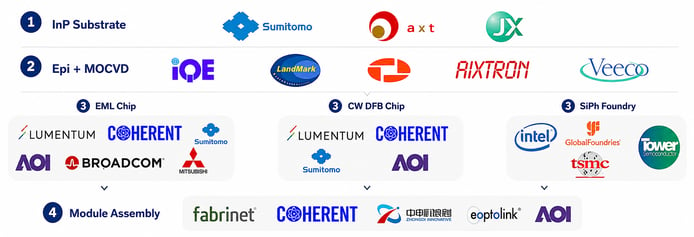 Source: SemiAnalysis, Aug 2026
Many of the above companies are holdings in LAZR, but not all. As of Aug 10, 2026, ACT (10.53%), IQE (2.03%), Landmark (3.78%), AIXTRON (8.45%), Veeco (2.41%), Lumentum (14.54%), Coherent (2.53%), AOI (4.61%), Tower (4.21%), and Eoptolink (2.69%) are holdings in LAZR. Consider fund risk and objectives before investing. For current fund information, holdings, and the prospectus, visit the LAZR ETF fund page.
How LAZR Is Positioned
Rather than trying to identify a single winner, the Tema Photonics & Optical ETF (LAZR) invests across the InP ecosystem.
LAZR’s top three positions are Lumentum (LITE), AXT (AXTI) and AIXTRON (AIXA). Each plays a different role in the InP supply chain: Lumentum makes InP lasers and optical transceivers, AXT supplies the indium phosphide wafers used to build them, and AIXTRON provides the specialised equipment needed to manufacture the laser chips.
AI investing has repeatedly shown that some of the greatest opportunities lie in overlooked parts of the supply chain. GPUs may capture the headlines, but they cannot communicate at scale without optical networking—and optical networking cannot function without InP lasers.
As AI infrastructure shifts from copper to optics, indium phosphide is emerging as one of the critical materials enabling the next generation of AI data centres. That could make it one of the most important, and underappreciated, investment themes in photonics.