


Key Takeaways
-
Drug discovery remains a costly and uncertain process, with most human diseases still lacking an approved therapy.
-
AI could turn drug discovery into an engineering discipline, capable of uncovering biology that has never been identified before.
-
Higher drug development success rates could create a drug discovery revolution by unlocking more treatments and creating significant value for both the healthcare industry and to patients.
The Challenge of Modern Drug Discovery
Modern drug discovery remains a costly and highly uncertain endeavor. Amazingly, bringing a single therapy from concept to market costs an estimated $2 billion.¹ Just over 1 in 10 drugs entering Phase I trials ultimately reaches patients—and far fewer succeed from the earliest discovery stages.1 The industry is vast: hundreds of billions of dollars are invested in R&D each year, and roughly 21,000 drugs are in development today.2
Still, only a fraction of diseases has an approved therapy. Many existing treatments do little more than slow progression rather than stop or reverse it. And many new drugs go after the same handful of targets.2 The result is a drug discovery system that’s been defined by enormous costs, high uncertainty, and persistently low productivity.
A Path to Biology as Engineering
AI could bring a more systematic, engineering-like approach to drug discovery, helping make the process faster, more predictable, and more data-driven over time. The transformation is likely to unfold in three stages.
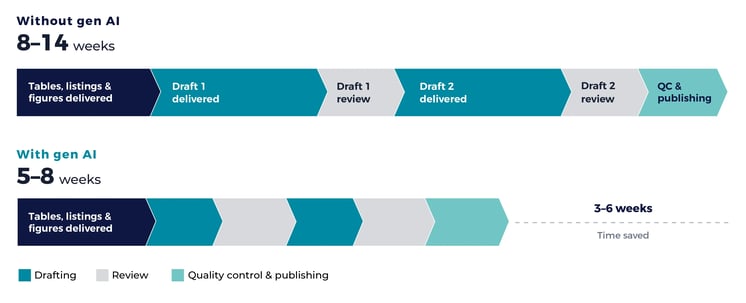
First, AI can reduce the time and cost of development by automating labor-intensive processes. Some of the most tangible benefits are emerging in documentation-heavy workflows, where AI is streamlining drafting and review processes that have traditionally taken up to 14 weeks to complete.3
AI Can Cut Clinical Study Report Drafting Time
Source: McKinsey & Company, January 2025
As these capabilities mature, AI could also improve the probability of success by helping researchers make better decisions throughout development, from clinical trial design to early identification of safety risks.
The next frontier is developing better medicines. Building on advances such as AlphaFold, AI is helping researchers identify novel therapies that are more effective and differentiated from existing treatments for a given target.
For most diseases, the challenge isn’t designing a drug. It’s understanding the biology well enough to know what drug should exist in the first place. Today, companies often concentrate on a relatively small set of well-understood targets because the risks of pursuing novel biology are so high. In fact, there are 37 targets that have over 50 competing drug programs against each of them.5 But if AI can help uncover previously invisible disease mechanisms, identify new therapeutic targets, and reveal entirely new treatment opportunities, it could dramatically expand the number of diseases that are treatable.
Early results are encouraging. Insilico Medicine's rentosertib, the first drug with both its target and molecule designed using generative AI, has already delivered positive Phase IIa data.4 Ultimately, the greatest opportunity is not to discover drugs faster, but to make more diseases treatable.
The Potential for an R&D Revolution
The prospect of such a transformation is already driving a wave of investment and activity.6 Billions of dollars have flowed into AI-native biotechnology companies, while leading AI labs are increasingly treating biology as a strategic frontier. Anthropic has launched science-focused initiatives, and DeepMind founder Demis Hassabis has concentrated his efforts on drug discovery through Isomorphic Labs.7 A growing number of AI researchers are turning their attention to biology, reflecting a belief that some of the next major breakthroughs in artificial intelligence may emerge from the life sciences.
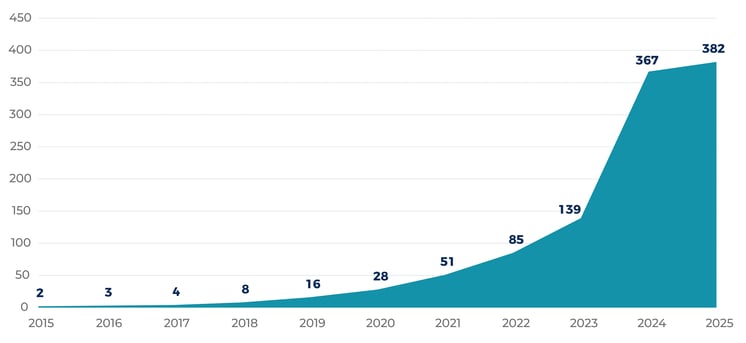
At the same time, the race is on to generate the massive datasets needed to train the next generation of biological foundation models, with the number of new biological AI models accelerating from single digits to more than 380 per year. 8
A Rise in Biological AI Models Is Raising Demand for Training Data
Source: Bessemer Venture Partners, "Building biology-native data infrastructure for the AI era," Apr 2026
While projects such as AlphaFold demonstrated the power of large-scale biological data, many researchers believe far richer datasets spanning cells, tissues, and disease states will be required to model biology at a deeper level. Researchers estimate that future biological foundation models may require thousands of times more data than many of today's largest biological datasets.9 Building those datasets may ultimately prove as important as developing the models themselves.
Expanding Possibilities
Multiple studies are pointing to real gains in drug discovery efficiency from AI. If drug discovery begins to resemble an engineering discipline more than a process of hypothesis testing and iteration, the probability of success could rise meaningfully over time. For investors, that matters when biotechnology has historically been constrained by long timelines, high failure rates, and uncertain returns. Even a modest improvement in success rates, from 10% to 20%, could dramatically increase the number of drugs reaching patients while simultaneously improving the productivity of industry R&D spending.9
The Bottom Line
Much of this potential remains underappreciated. Healthcare continues to trade at a discount to many growth sectors,10 despite the possibility that AI could reshape the economics of drug discovery over the coming decade and dramatically improve patient outcomes in the process.
One way to access this opportunity is through Tema's Healthcare AI ETF (HLTH), which is the first and only ETF of its kind, providing actively managed exposure to companies leveraging AI to transform healthcare. The fund invests directly in established biopharmaceutical companies applying AI to drug discovery, including Revolution Medicines and Vertex Pharmaceuticals.