


Key Takeaways
-
Equal weighting appears to solve the S&P 500’s concentration problem, but trades it for two structural flaws: High and increasing turnover and tracking error.
-
The rigidity required to maintain equal weights generates frictional costs that compound over time—and rarely show up until they’ve already eroded returns.
-
There is a middle path: Meaningfully less concentrated than cap weighting, without the distortions that equal weighting introduces.
By now, it’s no secret: The S&P 500 has a concentration problem. The combined weight of its ten largest holdings has surged past dot-com era peaks. A natural response, particularly for those who want to stay invested in S&P 500 companies without riding that concentration higher, has been to turn to equal weighting.
We recently explored how weighting schemes shape portfolio outcomes, and why neither market-cap nor equal weighting is as neutral as it appears. This piece focuses on equal weighting specifically: Why it seems like the obvious fix, and where that logic breaks down in practice. We also look at what a more deliberate alternative looks like—one that reweights the S&P 500 using historical averages.
Equal Weighting's Promise and Its Cost
Equal weighting has intuitive appeal. If you think the market’s biggest stocks are overvalued, or that the index has simply become too top-heavy, why not spread your bets evenly? Give every company the same shot. It sounds prudent, almost democratic.
The problem, as Jason Zweig explored in a recent Wall Street Journal column, is that simplicity in concept rarely survives contact with market realities. Strategies that look compelling on paper carry costs that don’t exist in back-tests. Equal weighting carries two such flaws that quietly erode the return advantage it appears to offer: Excessive turnover and persistent tracking error. Together, they make it a strategy that tends to look better in theory than it does in your brokerage account.
The Turnover Problem
Because an S&P 500 equal-weighted index ignores market cap, it has to push against the market constantly. Every time a stock moves—up or down—it drifts away from its target weight of 0.2%. That means at its quarterly rebalance , the equal-weight methodology is selling winners and buying laggards in large quantities to maintain its mandated structure. It isn’t expressing a view; it’s a mechanism running on a schedule
The S&P 500 makes this cost visible at scale. Across the past seven quarters, the equal-weight index averaged nearly 6% in quarterly turnover—more than six times that of the traditional cap-weighted S&P 500 index, and roughly 65% higher than a historical-weight approach.
|
Portfolio Turnover (%) |
S&P 500 Equal Weight |
S&P 500 Historical Weight |
S&P 500 Cap-Weight |
|
Q1 2026 |
7.4% |
2.9% |
0.6% |
|
Q4 2025 |
7.2% |
3.3% |
0.6% |
|
Q3 2025 |
6.6% |
3.6% |
1.3% |
|
Q2 2025 |
5.0% |
3.4% |
0.6% |
|
Q1 2025 |
5.4% |
2.9% |
0.4% |
|
Q4 2024 |
6.7% |
4.3% |
0.6% |
|
Q3 2024 |
5.9% |
3.7% |
1.0% |
|
Q2 2024 |
6.1% |
4.1% |
0.8% |
|
|
|||
|
Average |
5.83% |
3.48% |
0.92% |
|
Median |
5.63% |
3.40% |
0.83% |
Source: S&P Data, Tema calculation, as of Mar 31, 2026
For investors, that difference compounds across three dimensions:
-
High transaction costs from more frequent trading
-
More taxable events, particularly from the systematic selling of winners
-
A shorter effective holding period per position, given the magnitude of rebalances
The Tracking Error Problem
Equal weighting also produces significant tracking error relative to the S&P 500 benchmark, which can be problematic for investors trying to keep up with the index.
By systematically underweighting the S&P 500’s largest constituents, an equal-weighted strategy makes a structural bet against its leading companies . In years when the largest companies lead markets higher, as we’ve seen in recent years, that bet is punishing. The result is large-cap exposure that looks unrecognizable relative to the familiar benchmark.
| Overlap with S&P 500 |
Tracking Error (1-Year) |
Beta (1-Year) | |
| S&P 500 Historical Weight |
83% |
2.82% |
0.92 |
| S&P 500 Equal Weight |
46% |
7.39% |
0.82 |
Source: S&P Data, Tema calculation, as of Mar 31, 2026
Critically, this is a structural problem. When the S&P 500 Equal Weight Index launched in 2003, overlap with the cap-weighted benchmark exceeded 80%. The driver is simple: The range of market caps within the index has expanded dramatically. General Electric, the largest S&P 500 company in 2003, had a market cap of approximately $150 billion; today that title belongs to Nvidia at roughly $4.4 trillion. As dispersion grows, overlap will keep shrinking and tracking error will keep rising.
We believe today's record concentration will eventually mean revert—but that prospect remains uncertain. At any point in time, the aggressive equal-weight position introduces immense tracking error inherent to the methodology.
The Goldilocks Solution?
We believe the concentration problem with the S&P 500 is real—and it could deepen further if mega-IPOs like Anthropic and SpaceX achieve their rumored valuations. But the answer isn’t a methodology that overcorrects so aggressively it creates a new set of structural distortions.
Equal weighting sidesteps concentration by treating every constituent identically, putting Apple on the same footing as the 450th-largest company in the index. That isn't neutrality—it is an overly rigid solution applied to an increasingly dynamic market. A methodology designed for the market of 2003 is a progressively poorer fit for the market of 2026, and the divergence will only grow. That's a different kind of rigidity, and simplicity always has a price.
The S&P 500 Historical Weight Index takes a different approach. By reweighting constituents to their historical index ranking averages, it meaningfully reduces concentration in the top 10 while tracking the index far more closely than equal weighting is able.
Top 10 Company Weights
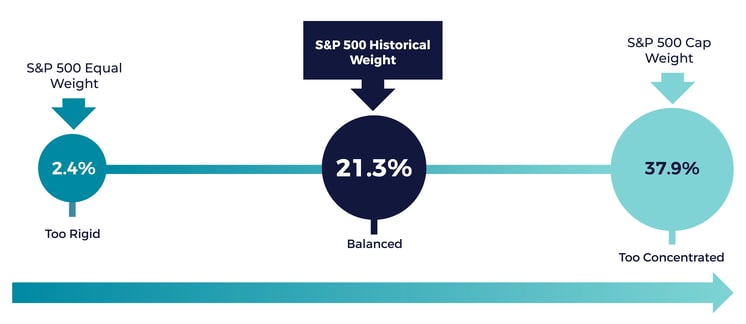
Source: Bloomberg. 1Historical Average based on monthly closing constituents of the S&P 500 since Dec 29, 1989. 2As of Mar 31, 2026 . All these comparisons are between indexes not ETFs.
Why It Matters for Investors
Concentration in the S&P 500 is a structural problem that isn't going away on its own. Equal weighting offers the appearance of a fix, but trades one form of rigidity for another, and investors quietly bear the cost. For investors managing benchmark risk, implementation costs, and portfolio credibility, the question isn’t whether concentration matters—but how much unintended drag they’re willing to absorb in trying to fix it. The S&P 500 Historical Weight Index addresses the problem without losing the index investors know and trust.
How to Invest
The Tema S&P 500 Historical Weight ETF (DSPY) offers full S&P 500 exposure, reweighted using historical averages to reduce concentration risk, without abandoning the large-cap index that investors know and trust.