

Key Takeaways
-
Semiconductor equipment makers control the critical process steps in chip manufacturing, with structural monopolies that AI demand reinforces. ASML controls 83% of lithography; KLA dominates metrology.
-
A new era of agentic AI is driving near-unlimited chip demand, accelerating fab construction at TSMC and drawing in new entrants, such as Elon Musk's planned Terrafab, sized at 70% of TSMC's current global output.
-
Mission-critical roles, deep customer integration, and sustained R&D reinvestment make these among the most durable franchises in technology. They benefit regardless of which chip designer or foundry wins.
Finding durable quality in technology is hard. Disruption is synonymous with the sector and that reality is only accelerating. It took Netflix more than three years to reach 1 million users, Instagram more than two months, and ChatGPT just 5 days.
However, one segment of technology is a rich seam of durable quality companies – semiconductor manufacturing equipment. These firms make equipment that is used to produce semiconductors at scale. Their equipment and services are essential purchases for companies like TSMC, Intel, and SK Hynix to make CPUs, GPUs, and memory in fabrication facilities (“fabs”) around the world. These are companies with strong moats:
-
Dominant: Semiconductor manufacturing equipment firms dominate their respective process steps. ASML has an 83% share of lithography patterning machines.1 KLA controls much of metrology inspection.
- Durable: These firms have enduring positions due to a powerful combination of mission-critical equipment, high switching costs (equipment is often aligned with roadmaps), technological lead, and reliability. This is all supported by reinvestment in R&D.
-
Tangible: Semiconductor manufacturing machines are physical, operating in some of the most advanced environments on earth. Unlike intangible software, chips are essential to deliver computing.
Semiconductor Manufacturing Equipment Vendor Map
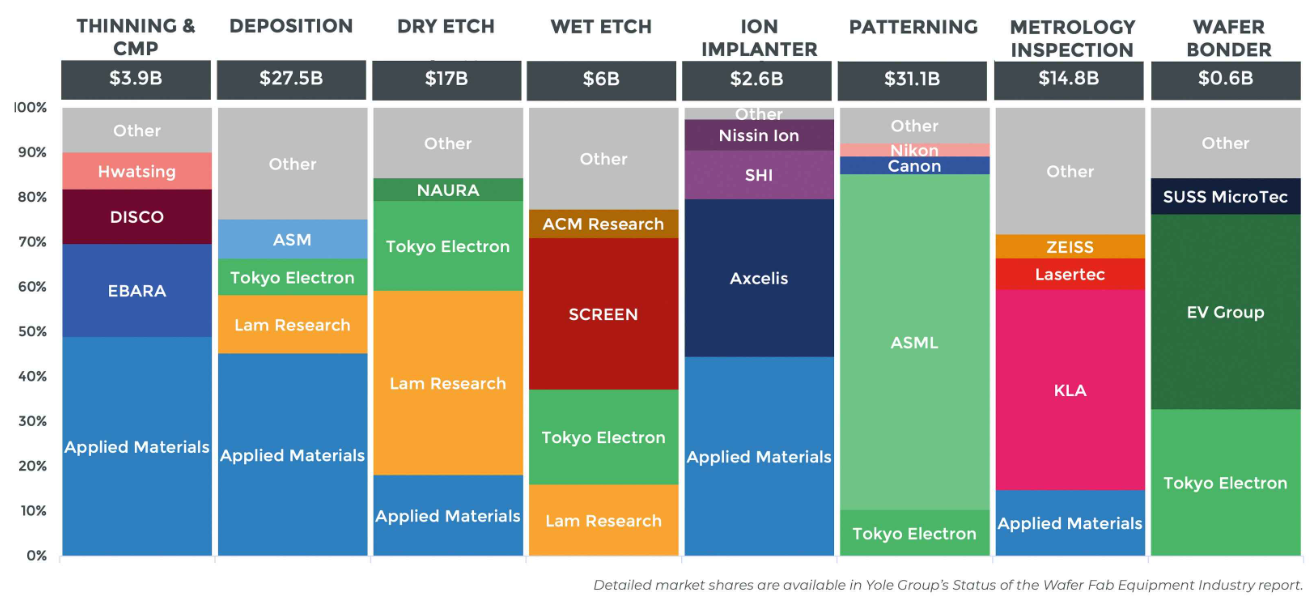 Source: Yole Intelligence, 2023 figures, as of Jan 2026
Semiconductor manufacturing looks like magic. Extreme ultra violet (EUV) machines, used to shoot patterns of light on silicon wafers in nano-meter geometries, stand four stories tall and cost $400 million apiece. These machines sit at the edge of physics, generating plasma from molten tin and bouncing it off mirrors so precisely that if magnified to the physical size of Germany, the imperfections would be measured in a few millimeters. Fabs operate at immense scale.
A Supercycle Is Coming
We are entering a new compute era. The old model was constrained by each device being owned one-to-one by humans. With agentic AI, each person can deploy multiple agents that interact with agents from other people and businesses, creating near unlimited demand for computing power.
A New Era of Computing Needs Lots of Chips
| Legacy Compute Demand Framework |
AI-Era Compute Demand Framework |
Demand was tied to devices people hold:
|
Demand is tied to agents acting on behalf of people. For example:
|
|
Bottleneck: Compute scales only with human-to-human or human-to-machine interaction = demand is finite |
No bottleneck: Agents can transact endlessly with one another = demand is effectively uncapped |
Source: Evercore ISI, as of Apr 2026
The complexity of chips is also growing. In the old compute model, chips for PCs and mobile phones had to fit into identical devices and hence were optimized for isolated functions and then integrated on a simple printed circuit board. In today’s new data-intensive model with high power consumption, each element is designed to work together. This integration falls onto the semiconductor company — to design a full compute system.
To make this growing number of more complex chips requires more advanced equipment—and more of it. The result is a rising investment cycle in semiconductor equipment as manufacturers, like TSMC, rush to upgrade equipment and build new fabs. Elon Musk is so worried about not having enough chips that he is planning to build his own fab to serve Tesla and SpaceX called the Terrafab. Its target capacity will be approximately 70% of TSMC’s total global output. Replicating such enormous capacity in one building requires semiconductor equipment of a sophistication produced by only a few firms globally, most of which are already capacity-constrained.2
The Semiconductor Equipment Market is Set for Strong Growth
Wafer Fabrication Equipment (WFE) Estimates
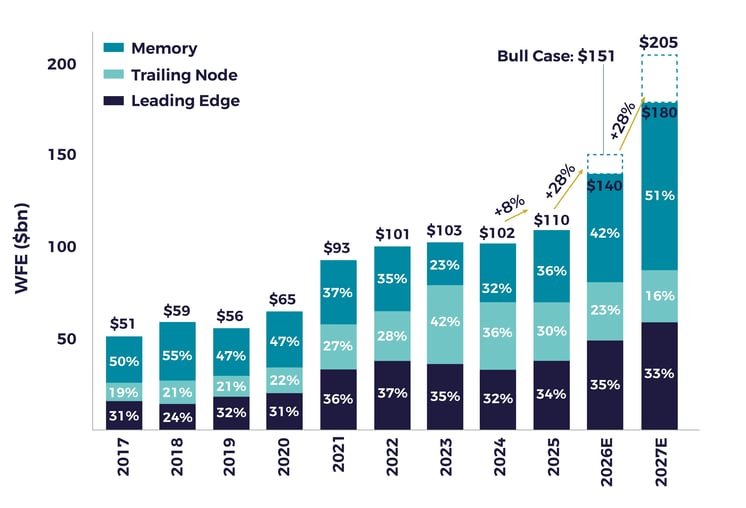 Source: Evercore ISI Research, as of Apr 2026
The Bottom Line
Semiconductor equipment companies sit at the foundation of the AI compute buildout. Without their machines, there are no chips, and without chips, there is no AI. Their structural dominance at critical process steps, combined with high switching costs and sustained R&D reinvestment, makes these businesses among the most durable franchises in technology. As the investment cycle in fabrication accelerates, driven by agentic AI demand and projects like the Terrafab, the equipment layer stands to benefit regardless of which chip designer or foundry ultimately wins.
The Tema Durable Quality ETF (TOLL) invests in a concentrated portfolio of such businesses, offering investors direct exposure to this structural growth in semiconductor equipment. Examples from TOLL’s portfolio include*:
-
Lam Research (LRCX): Supplies wafer fabrication equipment and services, especially for etch and deposition steps used to manufacture semiconductors with a major focus on memory.
-
KLA Corporation (KLAC): Provides process control, inspection, metrology, and yield management systems that help chipmakers monitor and improve semiconductor manufacturing.
- Applied Materials Inc. (AMAT): Makes materials engineering equipment, software, and services used to produce semiconductors, displays, and related electronic devices.
For more of our research and recent insights on durable quality and more, view and subscribe to our insights.
*Portfolio holdings are subject to change. For current holdings, visit the TOLL fund page.