


The U.S. has lagged other major economies—particularly China—in electrification investment for decades. That underinvestment is now colliding with a sharp acceleration in power demand, driven most notably by AI data centers and the reshoring of manufacturing. The U.S. is expected to host roughly half of all planned global data centers.1 The result is a clear catch‑up dynamic: Closing this gap is creating a multi‑trillion dollar opportunity across the electrification landscape.
The shortfall is visible across the entire power ecosystem. U.S. generation capacity has barely increased since 2005, while China’s installed electricity capacity has expanded roughly sevenfold over the same period, far outpacing both the U.S. and Europe. Consequently, Chinese power generation has grown at an average annual rate of 8% since 2005, compared with just 0.4% in the U.S.2
The U.S. Has Lagged in Installed Electricity Capacity, China Has Surged
Electricity Installed Capacity 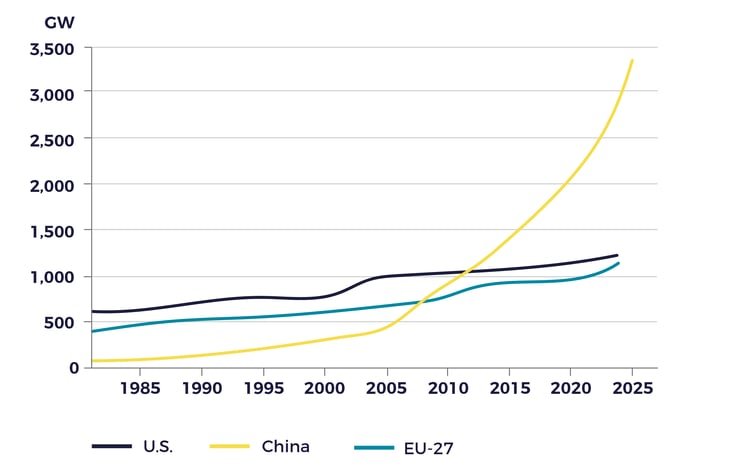
Source: Goldman Sachs, as of Dec 2025, Energy Institute data for 1980-2023 for EU-27, US, China. China series extended to 2024 using Wind estimates (track Energy Institute data).
The U.S. power grid is among the oldest in the world, with an average age approaching 40 years—older than nearly all peers except Europe—and is nearing the end of its intended design life. This stands in sharp contrast to China’s grid, which averages just 12 years old. The infrastructure gap is striking. During the 2020s, China has completed more than 8,200 miles of ultra-high‑voltage transmission lines, compared with just 375 miles built in the U.S.
Elsewhere, Europe is rapidly expanding cross‑border transmission to better balance supply and demand, while more than 125,000 miles of high‑performance conductors have been installed across India, Europe, and China combined. The U.S. accounts for less than 10% of that total.3
How to Invest in U.S. Electrification
Assessing a theme requires appreciating where the greatest opportunities are geographically and investing accordingly. Backward looking indices that rely on market cap weighting can often lead investors astray. Despite what we see as an outsized opportunity in the U.S., a leading electrification index skews international.
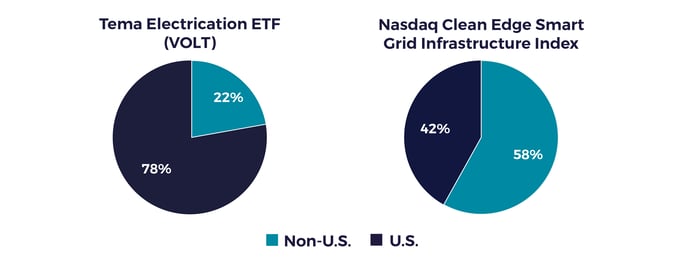
Source: Bloomberg and Company Level Data. Tema Analysis. Using last fiscal year end. Weighted average based on position size as of November 2025.
By contrast, the Tema Electrification ETF (VOLT) invests in companies directly exposed to U.S. electrification opportunities across power generation and the grid. Our analysis shows that nearly 80% of revenue across the portfolio is earned in the U.S. market.
For more of our research and insights on electrification and more, view and subscribe to our insights.