


Key Takeaways
-
Private credit is showing real strain. Defaults, write-downs, and redemption pressure are exposing risks that were easier to ignore in a more benign environment.
-
The backdrop is getting harder. Years of low defaults, limited price discovery, and abundant liquidity are giving way to a more demanding credit cycle.
-
Alternative asset managers may be the cleaner way into private markets. While private markets remain attractive over the long term, owning the platforms that manage those investments can offer broader diversification, better liquidity, and more flexibility than owning individual funds or loans.
Turbulence in private credit, from isolated defaults to growing concerns around software-sector lending, has reignited debate over the risks in this fast-growing asset class. While much of the focus has been on individual funds, loans, or lenders, the current backdrop highlights an important distinction for investors: Owning the managers of private assets can offer certain advantages over owning the assets themselves.
Market moves have shown how quickly sentiment can shift. A handful of portfolio write-downs and dividend reductions at several publicly traded BDCs triggered sharp share price declines, with some stocks falling close to 10% in a single day. Elevated redemption requests at funds such as Blue Owl Capital Corp. II (OBDC II) and Blackstone Private Credit Fund (BCRED) have added to concerns around liquidity pressure in private credit vehicles. Those worries have also weighed on listed alternative asset managers, with the group down roughly 20% year to date and valuations now about 20% below their 10-year average, versus roughly 10% above average a year ago.
These concerns should not be understated. Private credit has benefited for years from unusually low defaults, limited price discovery, and abundant liquidity. That backdrop is becoming less supportive. As the cycle progresses, losses are likely to rise and performance is likely to normalize from historically benign levels. Some of today’s issues may prove idiosyncratic, but the broader message is that private credit is not immune to economic stress, tighter financing conditions, or liquidity mismatches.
Why Managers May Be Better Positioned
For many investors, particularly in public markets, owning the general partners of private markets firms can offer a more diversified and resilient way to gain exposure to private markets growth.
One advantage is diversification across strategies, vintages, and asset classes. Individual private market funds or deals are often concentrated in a specific sector, vintage year, or underwriting environment. When stress emerges, whether in software lending, real estate finance, or leveraged buyouts, the impact can be significant for investors with direct exposure. As the chart below shows, returns for private equity buyout funds vary widely across both funds and vintages, especially in the post-COVID period.
A Wide Dispersion of Returns for Private Equity Buyout Funds Across Funds and Vintages
Buyout fund net IRR* by vintage year
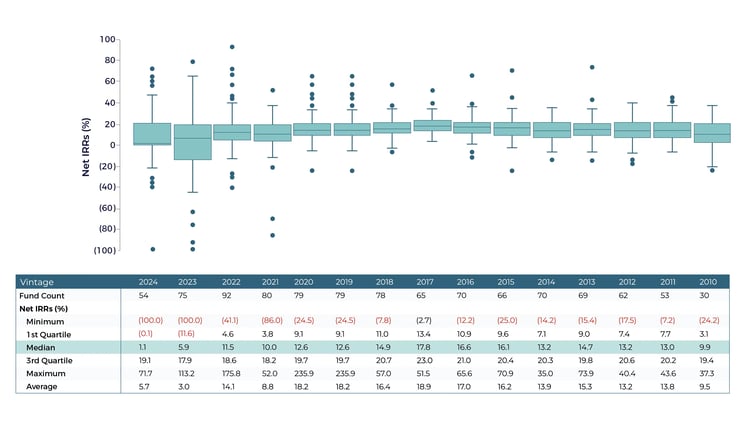
Note: The chart and table is based on sample data compiled by Bloomberg. Net IRRs as reported by the buyout funds grouped by vintage years. Source: Bloomberg, Tema ETFs, as of Mar 2026
Disclosure: Past performance is no guarantee of future results
By contrast, large alternative asset managers operate diversified platforms spanning private equity, private credit, infrastructure, real estate, and secondaries across multiple investment cycles. As shareholders in these firms, investors gain exposure to a broad base of underlying investments rather than a single pool of loans.
Alternative asset managers also offer greater flexibility and transparency than direct private market investments. Traditional private funds often require multi-year capital commitments and provide limited visibility into underlying holdings. Publicly traded managers, by contrast, offer daily liquidity, public financial disclosures, and ongoing insight into portfolio performance, fundraising trends, and deployment activity.
A Different Way to Access Private Markets
Another advantage is business-model diversification. Alternative asset managers generate revenue through management fees, performance fees, and investment income across their platforms. That allows them to participate in the long-term growth of private markets while retaining flexibility to direct capital toward the most attractive opportunities. During periods of dislocation, including the current stress in private credit, these firms may also be positioned to deploy capital more opportunistically.
Of course, there is a tradeoff. Investing in publicly traded managers rather than underlying funds may mean lower headline returns than a highly successful private fund or credit strategy. These stocks also carry public-market volatility and are marked to market continuously. Yet, according to our analysis, investing in alternative asset manager equities has generated higher average returns over the long run than investing in private funds. That may be due in part to a return profile that is more diversified and less dependent on the outcome of any single loan, deal, or vintage.
More broadly, today’s private credit stress reinforces an adage as old as time: Diversification matters. Direct exposure to private assets can deliver strong returns, but owning the platforms that originate, manage, and monetize those assets may offer a more diversified, flexible, and scalable way to participate in the long-term growth of private markets.
How to Invest in Alternative Asset Managers
For investors seeking diversified private market exposure to firms operating across private credit, private equity, venture, and real assets, the Tema Listed Private Managers ETF (PRVT) offers a curated portfolio of 25-35 companies. AAUM is managed by Investment Partner Kaimon Chung, CFA, who offers nearly two decades of experience covering alternatives.
For more of our research and recent insights on Alternatives and more, view and subscribe to our insights.