

AI breakthroughs have implications across many industries, but healthcare may represent one of the largest—and least understood—opportunities. Despite its potential, healthcare trades at a roughly 35% valuation discount to technology and AI-focused stocks.
Healthcare P/E is at a 35% Discount to Tech and AI Stocks
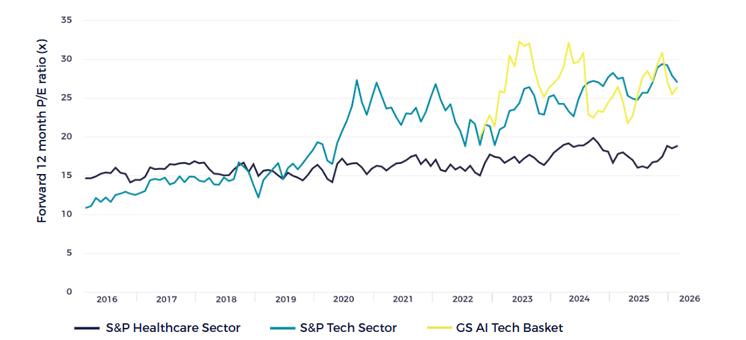
Source: Bloomberg as of 01/15/2026
Healthcare Stands to Benefit From AI Across the Entire Value Chain
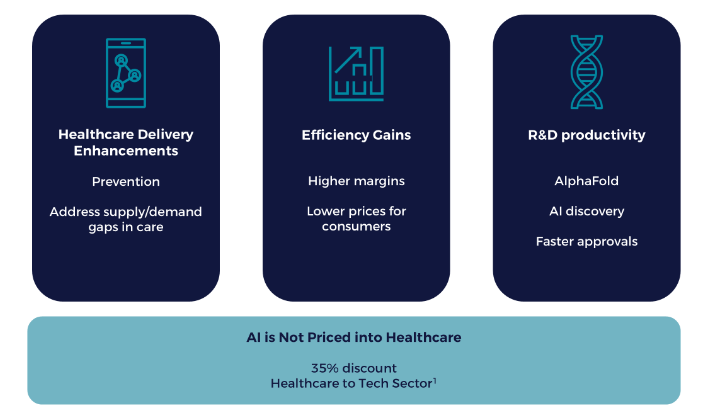 On the delivery side, the World Health Organization estimates a global shortage of 18 million healthcare professionals by 2030.1 AI can help close this gap by reducing workflow inefficiencies and integrating electronic medical records with large language models. According to Ernst & Young, healthcare has adopted commercial AI licenses faster than most other sectors.
Share of US Businesses Adopting Paid Commercial AI Licenses
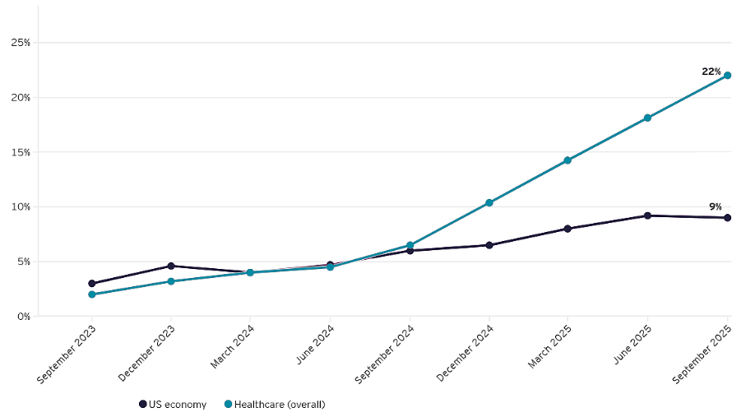
Source: EY, as of September 2025
The opportunity is substantial. U.S. healthcare employs roughly 22 million people2 and represents nearly 20% of GDP.3 Efficiency gains could lower costs, improve outcomes, and expand margins. Health services companies such as UnitedHealth and Oscar Health are already applying AI to improve care delivery, while medical device firms like Intuitive Surgical are integrating AI into robotic platforms to enhance consistency and outcomes in surgery.
“A lot of the expense is in workflow. If every provider can improve patient care and outcomes and reduce cost using AI, that will have a profound impact on our societies.”
Satya Nadella, CEO of Microsoft, December 2025
AI also has transformative implications for drug discovery. Biology is a data-intensive discipline, and advances in data collection—such as measuring thousands of proteins from a single blood sample—are accelerating progress.
Number of Proteins that Researchers Can Easily Measure in a Vial of Blood
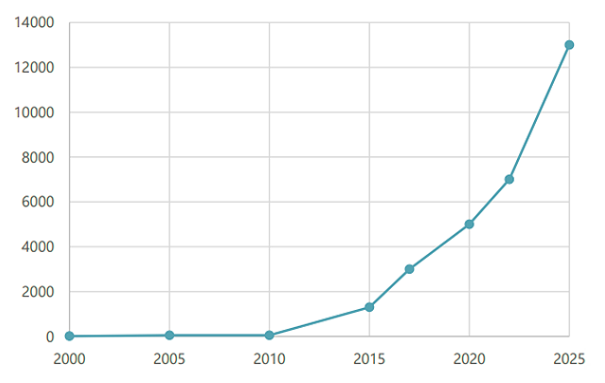 Source: PLoS One. 2016 Apr 22;11(4):e0154387; Aging Cell. 2010 Dec;9(6):1057-64. Commun Biol. 2021 Jun 18;4(1):758
AI tools like AlphaFold have solved protein structure prediction. AI software can sift through data libraries to identify viable drug candidates. These AI-designed molecules are now showing 80–90% success rates in early pre-clinical safety trials, compared with historical averages of 40–65%.4
Recently, Nvidia, Eli Lilly, and Thermo Fisher announced a $1 billion investment in an AI-powered drug discovery lab. A growing group of “tech-bio” companies, including Schrödinger and Recursion Pharmaceuticals, are applying these tools with the potential to reshape drug development.
For a broader perspective on healthcare, review our white paper, "Healthcare's Next Cycle is Taking Shape." For more of our research and recent insights on healthcare and more, view and subscribe to our insights.