


Key Takeaways
-
Geopolitical shocks often hit defense, aviation, and energy simultaneously—but with very different timelines and sensitivities.
-
In defense, the central investable question is no longer whether demand exists, but whether production capacity and supply chains can keep up.
-
Europe appears to be at the start of a multiyear rearmament cycle, shaped by lessons from Ukraine and reinforced by spillover risks from Iran—keeping spending elevated, particularly in munitions, air and missile defense, and the industrial base.
Recent escalations involving Iran have underscored how quickly regional conflict can spill into the global economy. Following U.S./Israel strikes and Iran’s response, multiple Middle East air corridors have been restricted or closed, forcing airlines to cancel or reroute flights and triggering widespread passenger disruption across international networks.
The practical effect is a growing “hole in the sky.” Aircraft are being pushed into longer routings, driving higher fuel burn and cascading into crew, aircraft, and schedule dislocations across global systems. What begins as a regional military conflict rapidly becomes a global logistics issue.
Air and Missile Defense Becomes Stretched
A defining feature of the current conflict is the central role of air and missile defense. Sustained engagements consume high‑end interceptors at a rapid pace, turning replenishment into a strategic constraint—particularly when inventories are already stretched by recent and ongoing conflicts elsewhere.
In Washington, the near‑term emphasis is increasingly on accelerating production and delivery of critical munitions. The issue is not demand; it’s capacity. Manufacturing throughput, supplier depth, and the time required to expand production lines have become the binding constraints.
For investors, this distinction matters. Increased usage does not automatically translate into near‑term earnings upside. Procurement timing, contract structure, manufacturing ramps, and supply‑chain resilience ultimately determine whether demand converts into realized revenue and margins. In many cases, that translation occurs over years, not quarters.
Aviation and Energy Absorb the First-Order Shock
Civil aviation is typically the fastest transmission channel from geopolitics to realworld economic impact. With Middle Eastern airspace constrained and Russian airspace already unavailable to many carriers, global traffic is increasingly funneled into the South Caucasus air corridor. This has become one of the few remaining viable Europe–Asia routes, running north of Iran and south of Russia.
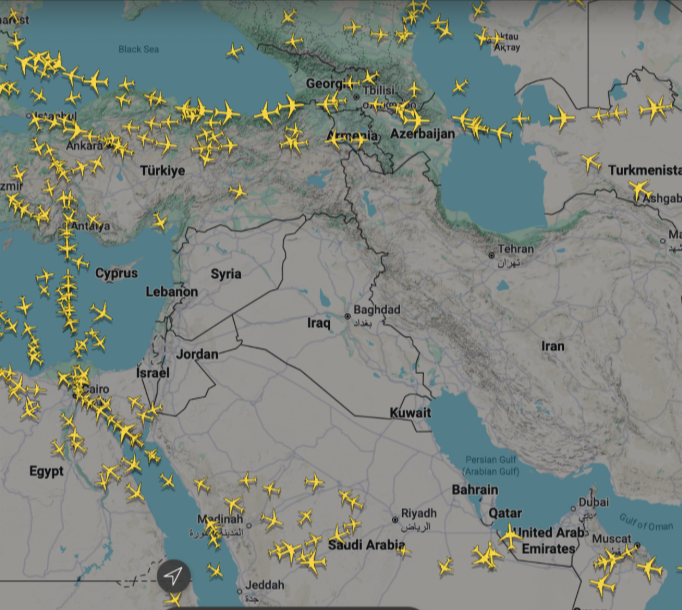 Above: Air traffic rerouted around closed Middle Eastern and Russian airspace is increasingly concentrated in the South Caucasus corridor, creating a narrow chokepoint for Europe-Asia travel.
Longer flight times raise fuel consumption and operating costs, while schedule fragility increases as traffic concentrates into fewer routes. The result is higher cost pressure and greater operational risk for airlines, even before demand effects are considered.
Energy is the other immediate linkage. Heightened geopolitical risk has lifted oil prices, which feeds directly back into airline economics and transport intensive parts of the global economy. Rising fuel costs amplify the operational challenges created by constrained airspace.
Aerospace sits between these forces. Aircraft manufacturers and key suppliers may continue to benefit from resilient, multiyear order backlogs, but near term sentiment and fundamentals can still be influenced by airline capacity decisions, route economics, and supply chain throughput. As in defense, backlogs alone do not guarantee near term revenue acceleration.
Europe is Increasingly Pivotal
Europe is where the defense cycle increasingly looks structural rather than cyclical. The conflict reinforces how decisive integrated air and missile defense can be, while also highlighting how uneven European coverage remains. It underscores the persistent gap between the U.S. ability to project force and Europe’s current dependence on external enablers, particularly in high‑end systems.
In this context, Europe’s rearmament is not simply about incremental budget increases. It is about rebuilding capabilities and, critically, the industrial base required to sustain them. That challenge has been visible since Russia’s 2022 invasion of Ukraine, which exposed stockpile inadequacy, production bottlenecks, and the reality that replenishment is a multi‑year exercise.
Capital markets are beginning to reflect this shift. A recent example is Czechoslovak Group (CSG), a fast‑growing European ammunition and defense manufacturer that came public in January. The IPO reflects both renewed investor appetite and the strategic push to expand Europe’s defense manufacturing capacity—an illustration of how industrial scale, not just spending commitments, is becoming investable. We discussed the setup and implications in our insight on CSG’s listing.
What It Means for Investors
The human costs and political complexities of conflict are profound and extend far beyond markets. For investors, however, the economic and industrial consequences are unavoidable. Modern conflict places sustained pressure on defense inventories, logistics networks, and energy systems—often revealing constraints that take years, not quarters, to resolve.
The current environment reinforces a central investment reality: Deterrence increasingly depends on production capacity, technological integration, and the resilience of the industrial base. That dynamic favors companies positioned to scale manufacturing, secure supply chains, and support next-generation defense systems over long time horizons.
The Tema International Defense Innovation ETF (GDFN) invests in companies critical to today’s global rearmament cycle, including Europe’s historic military buildup. The portfolio targets innovators at the forefront of defense applications for AI, cybersecurity, robotics, and more—technologies reshaping modern security.
For more of our research and recent insights on global defense and more, view and subscribe to our insights.