


The S&P 500 companies are a core allocation for most investors, representing some of the best businesses in the world. Yet, at this moment the top 10 stocks in the S&P 500 represent a record 41.2% of the index. This concentration represents a challenge and risk for investors. As we look to 2026 and beyond, how does one stay invested in the S&P 500 companies, while reducing concentration risk and without introducing unnecessary deviations (tracking errors)?
Concentration is a Big Risk to a Core Allocation
- Historically, levels of high concentration lead to poor forward returns in the S&P 500. The worse the concentration, the worse the returns. Current levels of concentration suggest a forward return on the S&P 500 Index of -5%1.
- Concentration also leads to more volatility as the index return becomes disproportionately dependent on single stocks. Today’s concentration suggests volatility above 20%2.
- Core allocations are meant to be diversified across, yet today S&P 500 investors are taking unprecedented individual stock risk. For these companies valuation is especially problematic with the average P/E of the top 10 nearly 57% higher than the other 490 companies3.
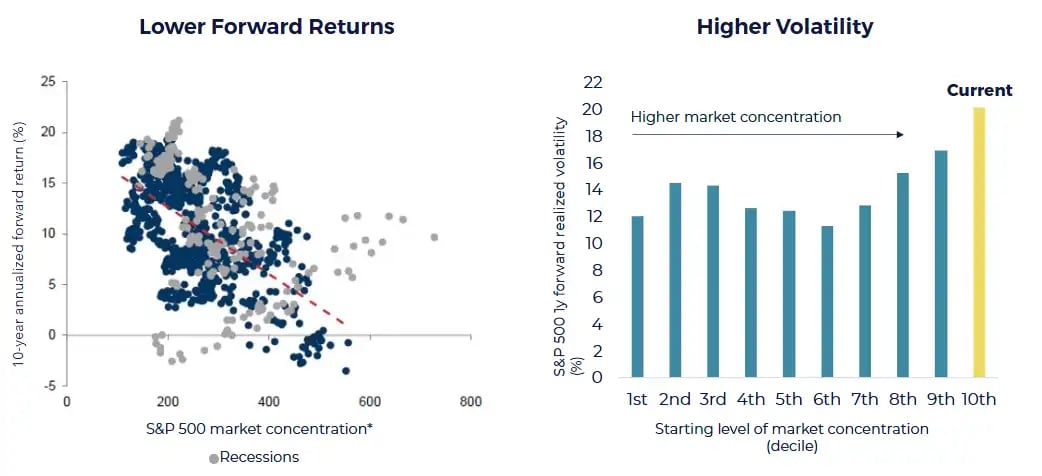 Source: Goldman Sachs GIR. *Market concentration is defined as the market cap of the largest stock relative to the 75th percentile stock; grey observations are recessions. As of September, 2025.
Most Solutions to Concentration Add Other Problems
One alternative is to invest in each S&P 500 company with an equal weight. This naturally solves concentration but introduces a host of other problems. Equal weight has:
- Low overlap4 of just 47% with the S&P 500
- Substantially different sector and factor exposures
- Higher (taxable) turnover, given frequent rebalance capping ability to “run winners”
As a result, this solution leads to very high tracking error of 7.9% vs. the S&P 5005.
DSPY is an Innovation on S&P 500 with Key Benefits
 Source: Bloomberg as of 09/30/2025. Volatility is standard deviation of return since inception of DSPY (May 2025). Dividend yield is based on consensus dividend forecasts for all S&P 500 constituents. Tracking error measured as of 09/30/2025 using Bloomberg MAC3 Model.
The Bottom Line
When managing risks, especially in core exposure, it’s key to not replace old risks with new risks. Reducing concentration risk of the S&P 500 today, while still maintaining high overlap with the S&P 500, requires a targeted approach. The Tema S&P 500 Historical Weight ETF Strategy (DSPY) offers investors a way to stay invested in the S&P 500 in 2026 but, by using historical average weights. This strategy reduces concentration risk, without introducing unnecessary tracking error.
For more of our research and recent insights like this, view and subscribe to our insights.